
A framing nailer helps you drive large nails quickly when you are building anything that needs strong structural support. You can use it for wall framing, roof trusses, subfloors, decks, fences, and even crates or pallets. It saves time and reduces strain, which can make demanding jobs much easier to handle. However, the right nailer depends on your project, and the nail style you choose can affect how well everything holds together.
What Is a Framing Nailer?
A framing nailer is a tool that makes heavy building work faster and less physically demanding.
You use a framing nailer when you need quick, strong fastening with framing nails in demanding tasks. It drives large nails into structural lumber with far less strain than hand nailing.
Many models include depth adjustment, which helps you set each nail properly. You’ll also see different magazine angles and nail collations, which help the tool fit tight spaces and feed nails smoothly.
Many models are pneumatic, so they use air power to deliver steady force. That matters when you need to keep moving through a job efficiently.
If you want a tool that performs like a reliable part of the crew, this one earns its place quickly.
What Framing Nailers Are Used For
Framing nailers do the heavy lifting on jobs where you need strength, speed, and less strain on your hands and arms.
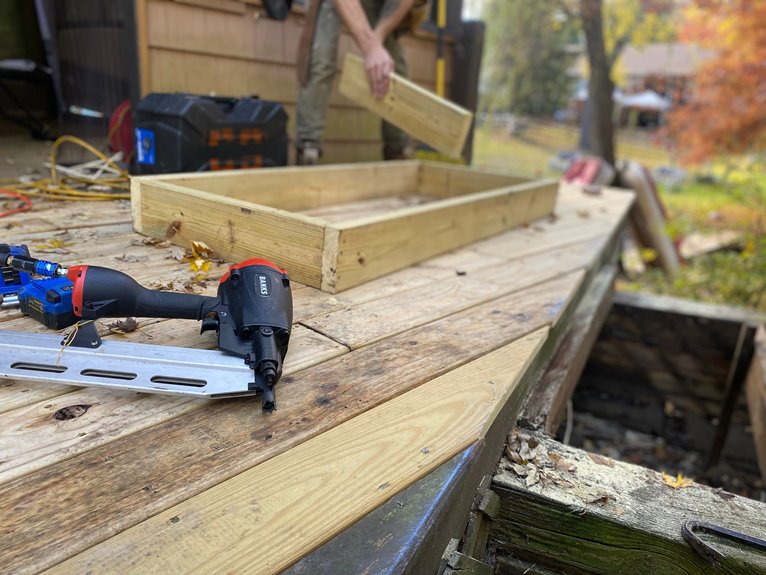
You use framing nailers, or framing nail guns, to drive long nails into dense lumber for wall framing, roof work, subflooring, and other structural builds. They fasten two by fours, joists, rafters, and engineered studs with steady depth, so your frame feels solid and trustworthy.
For deck framing, fence work, and crate assembly, they help you keep moving without tiring out.
Your framing nailer depends on the job because magazine angle changes how well you reach tight spots and how many nails you carry. That means you can match the tool to the space, keep your pace, and stay part of a crew that builds with confidence.
Best Projects for Framing Nailers
As you match the right tool to the right job, a framing nailer can turn tough builds into smooth, steady work. Use it for wall framing, roof truss assembly, subfloor installation, and decking. These jobs need fast, strong structural fastening, and your framing nailer helps you keep pace without losing control. When you build with a crew, the work stays coordinated and the frame rises together.
| Project | Why It Fits | Result |
|---|---|---|
| Wall framing | Fast nail drives | Solid stud lines |
| Roof truss assembly | Quick fastening | Safe, strong support |
| Decking | Wide surface coverage | Steady progress |
For heavier tasks, choose the right magazine angle so your tool reaches tight spots. Even crates and pallets can fit into the same reliable workday.
Framing Nailer Angles and Nail Types
As you move from choosing the right project to choosing the right tool setup, the magazine angle becomes just as important as the nail itself. When you choose a framing nailer, you’re also choosing how it feeds, fits, and reaches.
- 21° and 30° models often use full round head nails for strong holding power.
- 28° and 34° tools usually take clipped head nails, which can increase magazine capacity.
- A coil framing nailer with 15° wire collated nails keeps a compact profile.
- Steeper angles help you work in tight spaces and between studs.
Match the nail length and collation to the tool, or you risk jams and weak results. Once you understand these angles, you can feel confident working beside other builders.
How to Choose a Framing Nailer
Choosing the right framing nailer can save you time, reduce wrist strain, and keep your work cleaner from the very first drive. You match the tool to the job, and that helps you feel at home on the crew.
Start with magazine angle. A 21 or 30 degree framing nailer suits full round head nails, while 28 or 34 degree models slide into tight spaces.
Next, match the power source to your pace. Pneumatic tools suit steady professional use, while cordless or gas models give you more freedom.
Then check nail shank and length for better withdrawal resistance. Pick ring or screw shanks for framing strength.
Finally, compare sequential trigger control, magazine capacity, weight, and depth adjustment so you work faster without giving up comfort.
Framing Nailer Safety and Setup Tips
Before you fire a single nail, take a minute to inspect the framing nailer and set it up the right way, because a small check now can save you from a big headache later.
- Disconnect the air supply or battery before inspection.
- Check hoses, fittings, the trigger, and safety parts.
- Set the operating pressure to match the job.
- Load the correct nails for the magazine angle.
Wear PPE every time so you and your crew stay protected and confident.
Keep your hands clear of the muzzle, and never bypass the safety tip or anti-dry-fire feature.
Next, test-fire on scrap lumber and adjust the depth until each nail sits cleanly.
If you hit a jam, disconnect power first, remove the nails, open the nose, and check the driver blade before you reload.
This careful setup helps your framing nailer work smoothly.
Framing Nailer vs Finish and Brad Nailers
A framing nailer is a powerhouse, but it isn’t the right tool for every job, and that’s where the differences really matter.
You use a framing nailer for structural framing because it drives large nails with strong holding power into walls, roofs, decks, and subfloors.
In contrast, finish nailers handle baseboards, casings, and cabinets with smaller nails and cleaner results.
A brad nailer goes even lighter, so it works best for trim and delicate work where splitting is a concern.
When you compare a framing nailer vs a finish nailer, you’ll see one focuses on speed and strength, while the others focus on precision and a clean look.
Pick the right one, and you’ll be ready to get the job done well.
Frequently Asked Questions
What All Can I Use a Framing Nailer For?
You can use a framing nailer for roof sheathing, fence building, deck framing, log cabin construction, timber framing, shed construction, and pallet repair. Join the crew, build faster, and drive big nails with confidence.
Do I Really Need a Framing Nailer?
You probably do not need one unless you frame often. Compare the cost, rental options, noise concerns, storage solutions, learning curve, safety gear, and resale value. If you take on big projects, it will pay off.
What’s the Difference Between a Nail Gun and a Framing Gun?
A nail gun is the general-purpose tool, while a framing gun is the heavier-duty option within that category. You will notice differences in power sources, magazine types, trigger modes, safety features, and maintenance tips for your build.
What Kind of Nail Gun Do I Need for 2×4?
You’ll want a framing nailer for 2×4 fasteners, usually 21 degree or 30 degree angle framing, with a 90 to 120 PSI pressure setting and an air compressor. Choose a manageable gun weight, skip stainless nails, and avoid drywall workaround hacks.