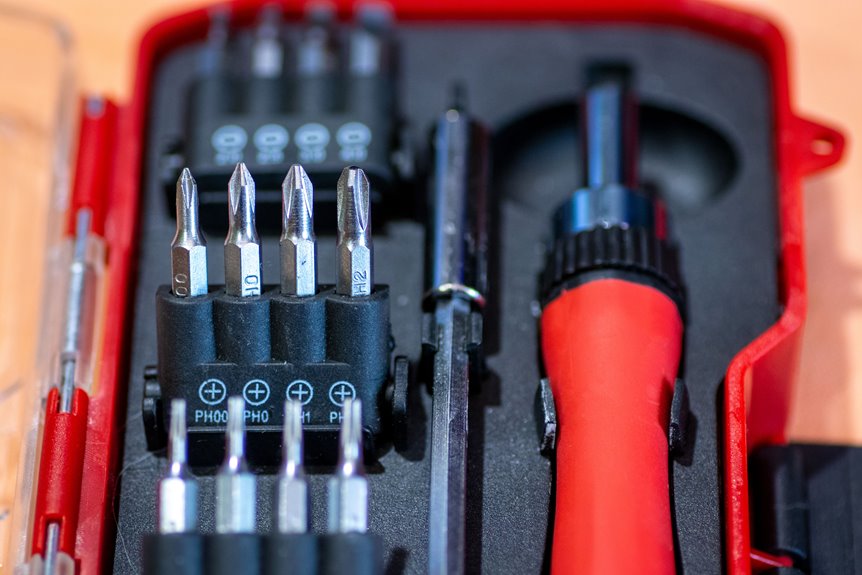

Like a trusted sidekick on a tough job, the right impact driver bit set can make your work feel smoother and safer. Look for impact-rated S2 or Cr-Mo steel, a torsion zone, and tips that match your most-used screws, especially PH2, T25, H4 or H5, and PZ2. Then the small details start to matter, and that is where the best sets quietly pull ahead.
What Makes a Good Impact Bit Set
A good impact bit set starts with tough steel, smart design, and the right mix of pieces, so you aren’t fighting your tools on every job.
You want impact-rated bits made from heat-treated steel because they handle torque spikes and stay strong longer. A torsion zone helps soften shock, while precision-machined tips grip fasteners cleanly and reduce cam-out. You’ll also feel the difference in a set with a 1/4 hex shank, since it locks in fast and keeps your workflow smooth.
Next, check the bit types and sizes so you have the common heads you use most. A magnetic bit holder adds control, and a durable case keeps everything together, ready whenever you are.
Match Bit Types to Your Most Common Screws
Start by looking at the screws you use most often, such as PH2, T25, and PZ2, so your bit set matches the jobs you actually do.
If you work on cars, bikes, or electronics, keep Torx sizes like T10 to T30 close at hand because they grip better and slip less than Phillips.
If you build furniture or use Allen head fasteners, add common hex sizes and a few core bits like PH1, PH2, PZ1, PZ2, and T15 so you’re ready for most tasks without searching for the right tip.
Common Screw Head Types
The right bit head can save you a lot of hassle, because the screw in front of you decides what belongs in your set.
For everyday work, keep Phillips bits, especially PH2, plus PH1 and PH3 for smaller and larger heads.
When you need stronger grip and high torque, Torx bits from T10 to T30 help reduce cam-out.
In European cabinets, Pozidriv bits matter, since a true PZ tip fits better than a Phillips tip.
For furniture, bikes, and machinery, Hex or Allen bits cover socket head and set screws.
Square or Robertson bits also deserve a place, because their tapered fit holds tight in wood and cabinetry.
A precision-machined tip makes each drive cleaner, and your set feels ready for real work, not guesswork.
Match Bit To Fastener
Match your bit to the screw you use most, because that simple step saves time, reduces slipping, and helps protect the fastener.
Start with the common screw heads in your shop: PH2 for wood and drywall, T25 for decking, PZ2 for European furniture, and #2 Robertson for Canadian builds.
Then match bit sizes closely, so PH1 fits small cabinet screws, PH2 fits common construction screws, and PH3 fits larger lag screws.
If you work with bolts, add the correct hex or socket sizes and impact rated bits for the job.
Look for a precision machined tip, S2 steel, and a torsion zone, because those features help impact rated bits last longer.
Keep the Torx and PH sizes you reach for most, so your set is ready when you are.
Keep Core Sizes Handy
Once you have matched the bit to the screw, keep your most-used sizes close at hand so you are not searching through a jumble while the job is already underway. Build your core around PH2, T25, and H4 or H5, then add PZ2 when working on European gear. The right setup helps you feel ready on any job, not like you are borrowing luck from the toolbox.
| Size | Best use | Why it matters |
|---|---|---|
| PH2 | Household screws | Fits the screws you meet most |
| T25 | Decking, auto work | Handles common torque |
| H4/H5 | Furniture, bike bolts | Matches hex fasteners |
Carry short and long bit lengths, about 25 mm and 50 to 75 mm, so you can reach tight or deep spots without swapping extensions. Choose impact-rated S2 bits with a torsion zone for your main sizes.
Choose the Right Bit Sizes
When choosing an impact driver bit set, size matters more than most people expect, because a loose bit can strip a screw quickly, and the wrong tip can turn a simple job into a frustrating one.
You’ll feel more prepared when your set covers PH1 to PH3, especially PH2, along with T10 to T30, with T20 and T25 ready for daily use.
If you work on decking or cabinets, keep PH2, PH3, and T25 or T30 close at hand.
For furniture and metric hardware, add hex H3 to H6 and square sizes #1 to #3.
For tighter jobs, choose both short and long bits, such as 25 mm and 50 to 75 mm, so you can reach deep spots.
A precision machined tip helps you work faster and with confidence.
Why S2 Steel and CR-MO Last Longer
Whenever you choose S2 steel, you get a bit that stays tough and resists chipping, even when your driver hits hard again and again. Cr-Mo adds another layer of confidence because it can flex under sudden torque instead of snapping, which saves you frustration on the job. Heat treatment then locks in that strength and toughness, so your bits can take more abuse and keep working longer.
S2 Steel Strength
S2 steel is a major reason some impact driver bits last long after cheaper ones twist, chip, or snap.
When you choose S2 tool steel, you get impact-rated heat treatment that builds toughness and shock resistance into each bit. That matters because the driver delivers fast torque pulses, and the steel must flex without failing.
Through quenching and tempering, manufacturers tune the metal for a balanced mix of hardness and resilience.
A chromium-molybdenum alloy can increase bit durability even further, especially when you’re working all day with the crew.
Add corrosion-resistant coatings, and your set stays ready, looks cleaner, and feels like gear you can trust.
The result is more confident fastening and fewer interruptions on the job.
CR-MO Breakage Resistance
CR-MO bits resist breakage because the alloy is designed for stress, not just sharpness. When you choose CR-MO impact bits, you get stronger breakage resistance during heavy driving and repeated impacts. Chromium adds hardness, while molybdenum adds toughness, so the bit core stays more stable instead of cracking.
That also improves fatigue resistance, which matters when the tool stays in the torsion zone again and again. With proper heat treatment, the metal can handle higher shear loads and hold its shape longer. You and your crew can trust that kind of durability on tough jobs. A smaller torsion zone can still perform well because the alloy already carries much of the load. Coatings help too, but CR-MO does the main work.
Heat Treatment Benefits
Heat treatment is what turns a tough alloy into a long lasting impact bit, because the metal doesn’t just need to be hard, it also needs to survive repeated hammering.
When you choose S2 tool steel or chrome moly (CR-MO), you get a base that handles shock better than ordinary steel. Quenching and tempering create a hardened tip for wear resistance, while the shank and torsion zone stay more flexible.
That mix helps your bit keep its shape, resist cam out, and deliver stronger fatigue resistance. You also get a smarter hardness gradient, so stress spreads out instead of cracking the tip.
Coatings can help with friction, but they can’t replace proper heat treatment. That’s why a well made bit feels steadier in your hand and lasts far longer.
Why a Torsion Zone Matters
While you’re driving screws hard and fast, a torsion zone can help protect your bit from a sudden twist and snap. In impact driver bits, this flexible design gives you a little give when torque spikes hit, so your tool keeps working with less strain.
You’ll notice the difference on long screws and lag bolts, where rigid bits can fail quickly. A good torsion zone also helps preserve the tip shape, which means less cam-out and better grip in the fastener. When you choose heat-treated steel with this design, you add real durability to your kit.
- It absorbs shock before the tip takes the hit.
- It helps your bit last longer.
- It keeps you on the job, not searching for replacements.
Pick Coatings That Cut Friction and Rust
A good coating can do more than make a bit look finished. It can also help it work more smoothly and last longer.
When you choose a TiN coating or another friction-reducing finish, you reduce heat and wear, so your bits keep their edge longer.
If rust is a concern, choose a corrosion-resistant finish such as black oxide or manganese phosphate, especially when you work in damp shops or outdoors.
Still, a coating can’t make up for a weak bit, so pair it with a heat-treated S2 core for real strength.
For daily jobs, magnetic coated bits can hold fasteners better and help you avoid fumbles.
For tough work, an impact-grade coating gives you extra durability without making the bit feel overly rigid.
Why Precision Tips Matter
Whenever you use a precision tip, it fits the screw recess more cleanly, so more torque reaches the fastener instead of slipping away. That tighter contact helps reduce cam-out, which means fewer stripped screws and less frustration on the job.
Even a small mismatch can turn a quick drive into a rounded mess, so the right tip shape really does matter.
Tip Fit Matters
Tiny bit tips can make a big difference here, because fit is everything once the driver starts hammering. When you choose the correct bit size, you engage the fastener, not fight it. Precision machined tips and a full contact tip grab more of the recess, so you can transfer torque cleanly and reduce cam out. A PH2 or T25 fit matters because the wrong match is where most damage starts.
Impact rated, precision heat treated bits keep their shape longer, so the tip keeps seating the same way, job after job. Look for laser etched markings and steady geometry across the set, then you can grab the right one fast and stay confident.
- Match the recess exactly.
- Choose full face contact.
- Replace worn tips promptly.
Reducing Cam-Out
Precision tips do more than feel good in your hand, because they help stop cam-out before it starts. When you use a precision-machined tip, you get more surface contact, so the bit stays steady instead of climbing out of the recess. That matters even more with impact-rated bits, since the pulses can shake loose a sloppy fit.
Choose the exact bit size, such as PH2 for common screws or T25 for many Torx fasteners, and you’ll reduce play quickly. Torx and square, also called Robertson, shapes give you better torque transfer, so you stay in control. Check for wear regularly. If the edges look rounded, replace them. Precision-fit tips keep you on the job, working cleanly, without stripped heads or that annoying slip.
Magnetic vs Non-Magnetic Bits
Should you choose a magnetic bit or a non-magnetic one? Magnetic bits are useful when you want better drop prevention and easier one-handed installs. They help keep screws steady overhead and can make framing or drywall work less fussy.
Non-magnetic bits are better when electronics safety or precision work matters more than grip.
- Pick magnetic bits for general construction when magnet strength helps hold fasteners in place.
- Pick non-magnetic bits when you need fast release or work near sensitive parts.
- Check coating choice too, because corrosion-resistant finishes can affect debris buildup and rust resistance.
Compare Milwaukee, DeWalt, Makita, and Bosch
Whenever you compare Milwaukee, DeWalt, Makita, and Bosch, you quickly see that each brand solves a slightly different problem on the job. If you want tough impact driver bit sets that feel like a trusted crew, Milwaukee’s Shockzone and forged tips bring strong grip and durability. DeWalt offers an extended torsion zone and, on some sets, a quick-lock shank for faster swaps. Makita leans on precision-machined, heat-treated steel and full-contact tips for a tight fit. Bosch blends heat-treated strength with an extended torsion zone and clear markings.
| Brand | Best for | Standout feature |
|---|---|---|
| Milwaukee | Heavy-duty use | Shockzone |
| DeWalt | Fast changes | quick-lock shank |
| Makita | Long wear | full-contact tips |
| Bosch | Easy reading | precision-machined tips |
You may choose the set that fits your work style.
How to Compare Bit Sets Before You Buy
Start by checking whether the bit set is truly built for impact driving, because that detail can save you a lot of frustration later. You want impact-rated bits made from heat-treated steel, since they hold up to hard torque pulses better than ordinary bits.
Then look at the torsion zone, because a longer flex area can soften shocks and protect the tip. A precision-machined tip helps you grip screws cleanly, and a 1/4 hex shank keeps swaps fast.
Next, compare the extras that fit your work style:
- A magnetic bit holder for one-hand control
- Laser-marked sizes for quick picking
- Socket adapters or nut setters for mixed jobs
Finally, check the brand warranty. It often tells you how much trust the maker has in the set, and that can make you feel more confident in your choice.
Pick the Best Set for Your Budget
Your best set often comes down to how much you plan to use it and how much you want to spend without regretting it later. If you’re keeping your impact driver ready for home fixes, a mid-range impact bit set with S2 tool steel and a 1/4 hex shank gives you solid value.
It covers common PH, PZ, TX, and hex sizes, so you’ll feel prepared without paying for extras you won’t use. For mixed DIY and work, look for heat-treated tips, an impact rating, and a corrosion-resistant finish.
If you use your gear daily, premium brands can save you money over time. Add a magnetic bit holder and a sturdy case whenever possible, because those small upgrades make every job smoother and keep you organized.
Frequently Asked Questions
What Is the Best Impact Driver Bit Set?
You’ll probably like Milwaukee Shockwave or DeWalt FlexTorq, while Bosch claims up to 10x longer life. Their material hardness, bit retention, torque delivery, magnetic tips, shaft length, corrosion resistance, and brand reputation all stand out.
What’s the Difference Between PZ2 and PH2 Bits?
PZ2 has extra ribs and a squarer tip geometry, while PH2 is a simpler cross. PZ2 offers better fastener compatibility, less screw stripping, and higher torque tolerance in Pozidriv applications. Choose harder, impact-rated bits for longer bit lifespan.
What Drill Bits Do I Need for an Impact Driver?
You need 1/4-inch hex shank, impact-rated bits, including Torx security, Phillips, and countersink bits for wood screws, plus magnetic holders, socket adapters, and metal drilling bits.
Are All Impact Driver Bits the Same?
No, not all impact driver bits are the same. You need the right bit material, bit length, bit tip, bit coating, bit tolerance, bit fitment, and bit hardness to work confidently and effectively together.