You want a moisture meter that makes sense in a real room, not just on a spec sheet. That means you need a tool that can read drywall, lumber, and other building surfaces without turning every check into a guessing game.
This roundup focuses on models that fit common homeowner, remodeler, and maintenance tasks, from checking a damp wall after a leak to screening firewood before it goes inside. You’ll see pinless options, pin-type tools, and a few hybrid picks, so you can match the meter to the way you actually work.
Quick Look At The Shortlist

Povlen Pinless Moisture Meter
Dr.meter Pinless Wood Moisture Meter MD918
PREXISO Wood Moisture Meter 7 in 1

General Tools MMH800 Pin/Pinless Moisture Meter

RDINSCOS Rechargeable Pinless Moisture Meter for Drywall

LASELION 2-in-1 Moisture Meter MS03

Wintact Pocket Wood Moisture Meter
More Details On Our Top Picks
The Povlen model fits the sort of work where you bounce between drywall, lumber, and masonry without wanting to change tools. A pinless design means it reads beneath the surface instead of leaving holes, so it suits finished walls, flooring, and stacked firewood more neatly than a pin meter.
That LCD display and sound alarm make it useful in a busy renovation or basement check, where you want a quick read and a clear signal. The trade-off with pinless meters is that they usually favor broad surface scanning over pinpoint depth, so this style works best for general checks rather than surgical troubleshooting.
Strong Points
- Pinless reading keeps finished surfaces intact.
- LCD output is easy to scan at a glance.
- Alarm feedback helps in noisy work areas.
- Works across wood, drywall, masonry, and concrete, which cuts down on tool swapping.
- Useful for everyday checks in a remodel, garage, or shed.
Things To Consider
- Pinless meters can feel less exact on tiny problem spots than a probe-style tool.
- Sound alerts are helpful, although some workspaces are quiet enough that you may rely on the screen more.
- Like most handheld meters, it works best when the surface is clean and the tool is stored dry.
Feature Snapshot
Who It Suits Best
You’ll get the most out of this one for home repairs, cabinet work, and general moisture spot-checks across mixed materials.
A Better Fit Elsewhere
General Tools MMH800 Pin/Pinless Moisture Meter suits you better if you want a broader hybrid setup with temperature and humidity alongside moisture readings.
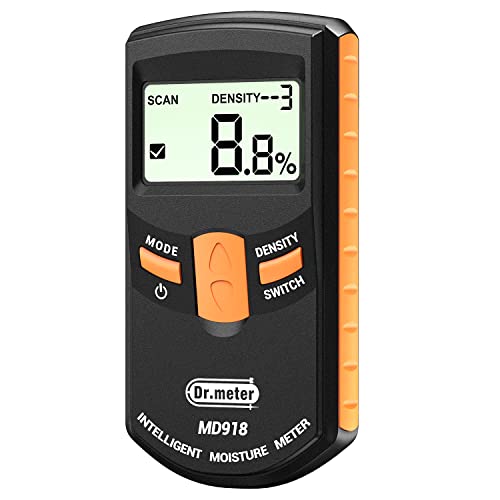
The MD918 keeps things simple, which helps when you just need a fast read on wood or firewood without a lot of menu chasing. Its 4% to 80% measuring span is wide enough for routine home and shop checks, and the pinless approach makes repeated scans less disruptive.
Compared with the Povlen model, this one feels more focused on straightforward wood use than multi-material coverage. That narrower lane can be an advantage for deck lumber, stored logs, or lumberyard sorting, though it won’t replace a more feature-heavy meter for drywall-heavy renovation work.
What We Like
- Wide measuring span handles many common wood checks.
- Pinless sensing keeps surfaces intact during repeat use.
- Direct wood-first design suits firewood and lumber tasks.
- Straightforward layout works well for quick spot checks.
Worth Noting
- Wood-focused design makes it less versatile than hybrid meters.
- It’s a better fit for scanning than for narrow, highly localized diagnosis.
- As with many handheld tools, keeping the sensing face clean helps consistency over time.
Core Details
Who Will Love This
You’re the best match for this meter if your work revolves around firewood, stock lumber, or general wood storage checks.
Skip It When
PREXISO Wood Moisture Meter 7 in 1 makes more sense for drywall and mixed-surface work because it brings several measurement modes to the table.
The PREXISO stands out because it does more than moisture alone, which matters in a shop or renovation where you want context, not just one number. It offers pin-type measurement, meaning the stainless-steel pins enter the surface to measure the material directly, so you get a more localized reading than a pinless scanner.
That extra detail comes with a trade-off, since pin meters leave marks and ask for a little more care during use. The mix of single-point, multi-point average, max and min modes, plus temperature and humidity readings, makes this a strong fit for you if drywall, paper, flooring, and wood all end up in the same project pile.
Reasons To Buy
- Seven calibration scales help cover several material types.
- Pin measurement gives a direct reading at the contact point.
- Average, maximum, and minimum modes add useful context.
- Temperature and humidity readings help explain indoor conditions.
- Backlit display improves visibility in dim rooms.
- Rubber side grips support steadier handling during repeated checks.
Small Caveats
- Pin contact leaves visible marks, so it suits unfinished or hidden areas better than decorative surfaces.
- More modes mean a slightly busier learning curve than a plain wood-only meter.
- The probe cover and pins deserve careful storage to keep them straight and protected.
Feature Card
Built With In Mind
You’ll appreciate this one most for renovation projects, finish carpentry, and mixed-material inspections where extra detail pays off.
Where A Sibling Pick Shines
Dr.meter Pinless Wood Moisture Meter MD918 fits you better for fast wood-only checks because its no-pin format keeps the process simpler.
The MMH800 earns attention because it bridges two styles in one body, which is useful for you if one day brings bare lumber and the next brings a finished wall. Temperature and humidity readings add environmental context, so you can think beyond a single moisture number and judge the room a little more clearly.
That broader feature set makes it feel more adaptable than the Dr.meter wood-first option, though it also means you’re buying a little more complexity. The honest read is that this suits someone who wants one meter for varied house and shop work rather than a narrow specialist tool.
Highlights
- Pin and pinless modes support different kinds of material checks.
- Temperature and humidity readings add room-level context.
- Useful for people who move between repair, inspection, and maintenance tasks.
- Can reduce the need to own two separate meters.
Points To Note
- Hybrid tools usually ask for a little more setup time than a single-purpose meter.
- More capability can mean more menu awareness during use.
- Storage matters, because the sensing surfaces and probes need to stay clean and protected.
Details At A Glance
Who Should Grab It
You’re a strong match for this meter if you handle routine home repairs, trim work, and occasional inspection tasks in different rooms.
A Better Fit Elsewhere
LASELION 2-in-1 Moisture Meter MS03 suits you better if you want a more straightforward dual-mode meter without the same amount of side information.
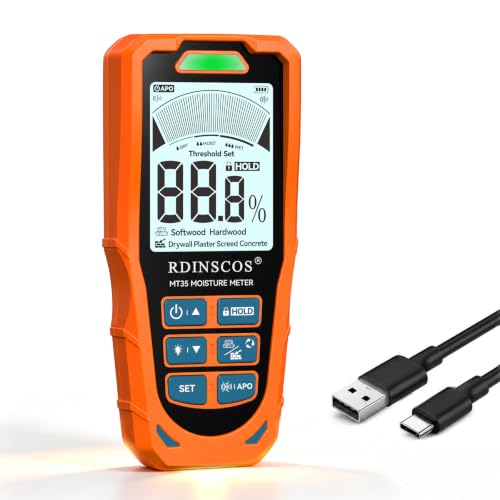
This RDINSCOS model keeps the focus on quick, non-invasive scans, which is handy in a home where you want to check walls, framing, or stacked lumber without leaving marks. The color display makes the reading easier to sort at a glance, and the built-in flashlight helps in closets, crawl spaces, or dim utility rooms.
Compared with the larger hybrid tools in this roundup, it feels lighter on extra functions and easier to grab for a fast pass through the house. That simplicity is its strength, although you may want something broader if your work shifts often between drywall, concrete, and more detailed diagnostic tasks.
Bright Spots
- Non-invasive scanning keeps surfaces untouched.
- Color display improves quick reading in a hurry.
- Flashlight helps in basements, closets, and shaded corners.
- Useful for wall checks, lumber sorting, and general household spotting.
Areas To Watch
- It is more of a fast scanner than a deep diagnostic tool.
- Brightness and screen visibility matter more in very sunny work areas.
- Like any pocket-style meter, it benefits from careful storage so the display and sensing face stay protected.
Core Details
Best Suited To
You’ll like this meter most for quick home checks, storage spaces, and general wall-to-wood scanning.
Another Choice May Suit
General Tools MMH800 Pin/Pinless Moisture Meter is the better fit if you want temperature and humidity readings alongside the moisture check.
Drywall work gives this RDINSCOS meter a clear job, and the rechargeable setup makes it feel more convenient for repeated checks around a renovation site. The adjustable alarm threshold matters because you can set the alert point around the task at hand instead of relying on a fixed trip point.
That focus on drywall, concrete, and flooring gives it a more specialized profile than the RDINSCOS pinless model above. You may find it especially handy during leak follow-up work or remodel prep, though the narrower specialty means it is not the broadest all-purpose meter in the group.
Upsides
- Rechargeable design cuts down on battery swaps.
- Adjustable alarm threshold supports more tailored checks.
- Pinless sensing keeps drywall and flooring intact.
- 6-in-1 format suits mixed jobsite tasks.
Room For Improvement
- Specialized drywall focus makes it less general than some hybrid meters.
- The alert setting asks for a little setup before the first use.
- Rechargeable tools do best when stored with some charge left in the battery.
Feature Rundown
The Right Fit
You’re the best match for this meter if drywall inspection, flooring checks, or renovation follow-up work makes up most of your routine.
Look Elsewhere When
Povlen Pinless Moisture Meter suits you better if you want broader material coverage for lumber, masonry, and everyday wall checks.
The MS03 is the kind of meter that makes sense for mixed jobs, because it gives you both pin and pinless styles in one handheld body. The hold function is useful when you need to freeze a reading while your attention shifts, and the flashlight plus auto power-off suit everyday carry in a toolbox or service bag.
Compared with the more specialized RDINSCOS drywall model, this one feels easier to hand to someone who needs a little of everything. One thing worth considering is that dual-mode tools ask for a bit more familiarity, but the payoff is flexibility across wood, concrete, and drywall.
Best Bits
- Pin and pinless modes widen the use cases.
- Hold function helps when the display is hard to view in motion.
- Flashlight supports work in dim corners and utility spaces.
- Auto power-off helps conserve the battery during routine use.
- Good fit for people who handle a mix of repair tasks.
Points To Note
- Dual-mode tools can take a little practice before they feel second nature.
- More flexibility means a slightly busier interface than a basic pocket meter.
- Keeping the sensing surfaces clean will help the tool stay dependable over time.
Spec Overview
Whose Shelf It Belongs On
You’ll appreciate this meter most if your projects bounce between drywall, concrete, and wood and you want one tool to cover the spread.
Reach For A Different Pick When
Dr.meter Pinless Wood Moisture Meter MD918 is the simpler choice for wood-only checks where you want less setup and fewer modes.
The Wintact pocket meter leans into portability, which is handy for you if you keep tools in a pouch, glove box, or compact service kit. Its pin-type design gives you a direct contact read on lumber, drywall, brick, concrete, and paper, so it suits quick spot checks where a non-invasive scanner is more than you need.
Relative to the larger hybrid picks in this roundup, it gives up some breadth in exchange for a smaller carry profile. That trade-off makes sense for field notes, maintenance rounds, and small jobs, although you’ll want to keep the probes protected so they stay straight and ready.
Positives
- Small size makes it easy to carry day to day.
- Pin-type contact supports direct material readings.
- Works across lumber, drywall, brick, concrete, and paper.
- Fits well into a pocket toolkit or small pouch.
Honest Caveats
- Pin-style reading leaves small marks on the surface.
- Compact meters can feel less comfortable for long inspection sessions than larger handled tools.
- The pins need careful storage, since bent probes can make routine use frustrating.
Technical Sheet
Perfect Match For
You’ll get the most from this meter in a small kit, especially for maintenance walks, outdoor storage checks, or simple field carry.
Swap It Out When
General Tools MMH800 Pin/Pinless Moisture Meter is the better fit if you want both pin and pinless capability in one unit.
How To Choose The Right Moisture Meter For Drywall And Woods
Match The Sensing Style To The Job
Pinless meters scan below the surface without leaving holes, so they suit finished drywall, painted walls, and furniture-grade lumber. Pin-type meters use metal probes that touch or enter the material, which gives a more direct contact reading but can mark the surface.
For renovation work, that difference matters. Pinless tools are easier to use on visible areas, while pin meters are useful when exact contact with the material matters more than preserving the finish.
Look Beyond Moisture Alone
Some meters add temperature and humidity, and those readings help explain why a wall or room feels damp in the first place. Environmental context matters in basements, laundry rooms, and garages where air conditions shift fast.
Models with average, max, and min modes also help you compare spots instead of chasing one isolated number. That’s useful on patchy drywall, uneven framing, or stacked firewood.
Think About Materials And Calibration
Wood, drywall, concrete, brick, and plaster do not behave the same way, so a meter with multiple calibration scales is often more practical. Calibration means the tool adjusts its reading behavior for different material groups, which helps the result fit the surface a little better.
That extra flexibility usually helps remodelers and maintenance pros more than casual users. A wood-only tool is fine for lumber and firewood, while a broader meter makes more sense for mixed home projects.
Small Details That Matter In Daily Use
Display quality, backlighting, hold functions, and alarm thresholds sound minor until you’re crouched in a dim utility space or working one-handed. A strong grip and auto power-off also make a difference during repeated checks.
Storage matters too. Keep the probes covered, avoid damp tool bags, and wipe off dust after use so the meter stays ready for the next wall, board, or beam.
What To Weigh Before You Click Through
Wrong Turns To Avoid
Plenty of people focus on range first and forget about the sensing style. That leads to a meter that reads well on paper but feels awkward on finished drywall or painted trim.
Another common slip-up is buying a wood-only tool for a job that also includes walls or concrete. You’ll save time later by matching the meter to the surfaces you actually inspect.
The Case For Spending Up
Higher-tier meters usually cost more because they add dual sensing modes, extra calibration scales, better displays, and more reading options. Those upgrades matter most when you move between renovation work, basement checks, and lumber evaluation in the same week.
Rechargeable power, flashlight aids, and adjustable alert points also push the price upward. For regular use, that extra convenience often pays off in time saved and fewer awkward workarounds.
Closing Thoughts
The right moisture meter should make your job calmer, not more complicated. For mixed drywall and wood work, a pinless or hybrid model gives you the most day-to-day flexibility, while a pocket pin meter stays handy for quick checks and portable carry. The cleanest choice is the one that fits your surfaces, your storage space, and the way you actually move through a project. Keep that in mind, and the shortlist gets a lot easier.