
If you have ever stood in a hardware aisle wondering why two sanders that look similar perform so differently, you are not alone. A random orbital sander removes material quickly without leaving swirl marks, while a palm sander offers more control for light touch-ups and tight spots. The difference comes down to how each tool moves, what it leaves behind, and which jobs it makes easier.
What Is a Random Orbital Sander?
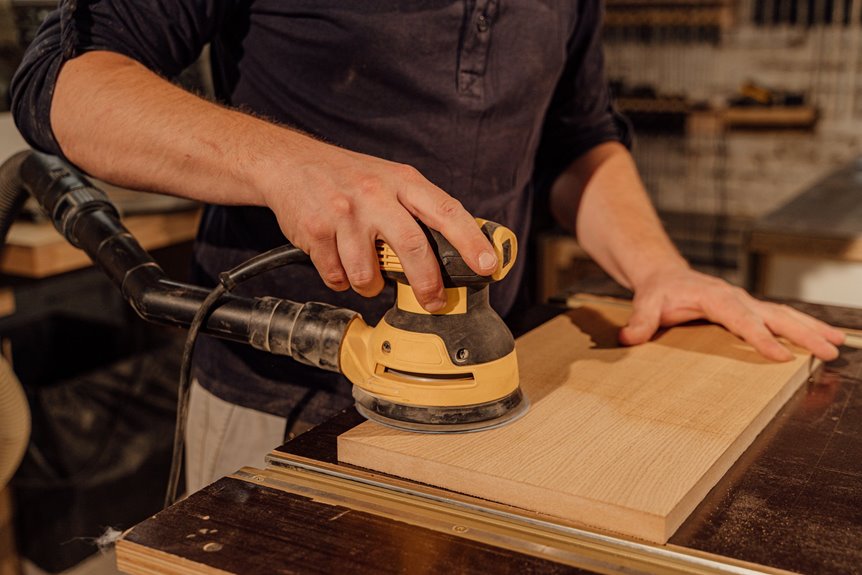
A random orbital sander is a useful power tool that helps smooth wood without leaving swirl marks behind.
You hold it against a board, and its round pad both spins and moves in an offset orbit. That dual action prevents the abrasive from following one path, so the finish is more even.
It typically runs at about 3,000 to 10,000 orbits per minute, allowing you to adjust the speed for the material and grit.
It also uses round sanding discs, often with hook-and-loop or PSA backing, and many models include dust ports for cleaner work.
It works quickly on large, flat surfaces, but the round pad can’t reach tight corners.
What Is a Palm Sander?
A palm sander is a small, lightweight power tool that fits in your hand and uses a square 1/4 sheet sanding pad.
You use it whenever you want gentle, controlled sanding, especially on edges, corners, small parts, and between finish coats.
It’s a simple tool, but it can save you a lot of fuss whenever smooth results matter more than fast stock removal.
Palm Sander Basics
If you have ever wanted a sander that feels easy to control, the palm sander is often a good place to start. It’s also called a 1/4 sheet sander because it uses one quarter of a standard 9 x 11 sandpaper sheet. This small, lightweight tool fits in your hand and helps you stay relaxed while you work.
Its square pad moves in short circular orbits, so it removes material gently rather than cutting aggressively. That makes it a smart choice for finish work, where you want smooth results without much effort. You can guide it into corners and along edges more easily than round pad sanders.
It’s affordable, easy to carry, and uses inexpensive quarter sheet paper, although the dust box fills quickly.
Common Palm Sander Uses
Because a palm sander is small, light, and easy to guide, it fits many everyday finishing jobs where control matters more than power.
You can use a palm sander for light-duty sanding on cabinets, trim, tabletops, and painted doors when you need a smooth touch rather than aggressive stock removal.
It works well between finish coats with 180 to 220 grit, so you can prep the surface for the next layer without scratching it.
Its square pad also helps you reach inside corners and tight edges that round sanders miss.
Since you can steer it with one hand, it’s useful for overhead spots and detail work.
It also costs less, uses inexpensive quarter sheets, and keeps the job moving.
Random Orbital Sander vs Palm Sander: What’s the Difference?
Which sander should you reach for first?
A random orbital sander has a 5 to 6 inch round pad that spins and orbits, so it’s well suited to broad panels and a smooth sanding finish.
A palm sander uses a small square pad with quarter sheet paper, and it moves in tiny circles for gentle control.
You’ll usually find the palm sander lighter and easier to guide near edges, inside corners, and finish coats.
The random orbital sander is heavier, more powerful, and often has better dust collection, so it’s better for larger jobs.
The palm sander costs less to operate because the paper is inexpensive.
If you want a simple workflow, start with the random orbital sander, then switch to the palm sander where detail matters.
Which Sander Removes Material Faster?
If you want to remove material faster, a random orbital sander usually wins because its larger pad and stronger motion cover more surface and cut more aggressively.
You’ll also notice that its higher power and better dust clearing help it keep working quickly, while a palm sander stays gentler and more controlled.
For heavy stripping or rough leveling, use the random orbital sander.
For finish work or tight spots, choose the palm sander.
Removal Speed Differences
Whenever you need to remove material fast, a random orbital sander usually wins the race. Random orbital sanders remove material faster because their larger pads and mixed spin and orbit action bite into wood with more reach and fewer passes. A 6 inch pad gives you about 45 percent more abrasive than a 5 inch one, so you cover broad panels quicker. Most models also run around 12,000 to 15,000 orbits per minute, and that extra motion helps you strip stock with confidence.
A palm sander stays gentler. Its 1/4 sheet pad and smaller fixed orbit make it better when you want control, not speed. So when your team needs fast results, reach for the random orbital sander. You’ll feel the difference right away.
Power And Coverage
A random orbital sander usually removes material faster because it combines more power with greater coverage. When you compare a random orbit sander with a palm sander, the difference is obvious quickly. The larger 5 to 6 inch pad gives you about 45% more abrasive area, so material removal feels stronger and smoother. A palm sander uses a smaller pad and gentler motion, so it stays in the lighter range.
| Sander | Coverage |
|---|---|
| Random Orbit Sander | Larger pad |
| Random Orbit Sander | Stronger motor |
| Random Orbit Sander | Faster cutting |
| Palm Sander | Smaller pad |
| Palm Sander | Softer finish |
That extra reach helps you approach sanding with confidence, not guesswork.
Best Use Cases
Whenever you need to remove material fast, a random orbital sander is usually the better choice because it gives you more power, more pad coverage, and faster cutting in one tool. You’ll feel the difference on large panels, rough boards, and finish stripping jobs where you want progress, not patience.
- Its 5 to 6 inch pad covers more wood with each pass.
- Its rotating and orbital motion cuts varnish and rough grain quickly.
- Optional speed control helps you match the job.
- A palm sander works best for corners, touch ups, and sanding between coats.
How Does a Random Orbital Sander Finish?
Whenever you use a random orbital sander, the finish usually looks smooth, even, and much less swirled than what you’d get from a simple rotary tool. That happens because the pad spins and orbits at the same time, so the random orbital action helps hide swirl marks and leaves a smoother finish you can feel proud of.
You can move through grits from rough to fine, such as 80, 120, then 180 or 220, and each step makes the surface cleaner. Light, steady pressure works best, since pushing too hard can leave tiny scratches. Variable speed also helps you match the job. Strong dust removal keeps the pad cutting well, so you get a clean, consistent result on big flat surfaces.
What Is a Palm Sander Best Used For?
You’ll get the best results from a palm sander whenever you need light finishing work that smooths surfaces without removing too much material.
It’s also a great fit for tight corners, edges, and trim where a bigger sander can’t reach.
When you’re sanding between coats, its gentle motion and fine grit paper help you prep the surface without leaving deep marks.
Light Finishing Work
For light finishing work, a palm sander really shines because it gives you control without feeling harsh or clumsy. You can trust it for light-duty sanding whenever you want a smooth surface, not a deep cut. Its small pad and gentle motion help you finish wood with less risk of marks.
- Smooth between coats
- Prep for 180 to 220 grit
- Reach corners on trim
- Touch up light paint
Because the palm sander removes little material, you stay in control while you work on furniture, narrow stock, or delicate panels. It’s also handy whenever you need to reach corners that round tools miss. Just keep an eye on the paper and dust bag, since both fill up fast during finish work.
Tight Corners And Edges
Around tight corners and along crisp edges, a palm sander earns its keep fast. You can guide its small square pad into inside corners, door jambs, and narrow spots where a round tool just won’t fit.
The flat base stays close to trim and moldings, so you won’t overhang the abrasive past the workpiece. That steady sanding motion helps you round sharp corners without chewing up nearby surfaces.
Because the palm sander cuts gently, you can shape detailed areas with more control and less stress. If you’re refining furniture edges or fitting up a trim piece, it feels like a helpful teammate.
Just keep an eye on the dust bag, since it fills quickly in tight corners, and empty it often.
Between-Coat Sanding
Between coats, a palm sander is one of the safest tools you can use when you want a smooth finish without undoing your earlier work. It fits well into between coat sanding because its small pad and gentle motion lightly smooth the surface instead of cutting into it. Use 180 to 220 grit, and you’ll scuff the old coat just enough for the next one to bond properly.
- It helps flatten raised grain and dust nibs.
- It reaches edges and inside corners with ease.
- It removes less material, so you stay in control.
- It fills its dust bag fast, so check it often.
When you move the palm sander steadily and avoid pressing down, you protect the finish and keep your project looking clean and professional.
Which Sander Handles Large Surfaces Better?
A random orbital sander usually handles large surfaces better because it lets you cover more wood in less time without making the job feel like a chore. When you’re smoothing big tabletops or wide panels, its larger pad and fast rotating orbit help you move quickly while keeping swirl marks low.
A 6 inch random orbital sander gives you more contact area than a 5 inch model, so you can finish the job faster with less stopping. A palm sander still has a place, though. It works well for edges, corners, and smaller pieces where control matters more than speed.
For broad, flat work, the random orbital sander gives you a stronger, more confident feel, and that can make the whole project feel more manageable.
How Does Dust Collection Compare?
Anytime dust control matters, a random orbital sander usually pulls ahead because it can capture much more debris as you work.
It offers better dust extraction through multi-hole pads and vacuum ports, so less grit hangs in the air and settles on your project.
That means cleaner edges and a calmer workspace for your crew, whether it’s one person or several.
- A random orbital works with matched sanding discs for stronger pickup.
- A shop vacuum or dust bag can improve collection quickly.
- A palm sander often uses a small bag that fills quickly.
- Quarter-sheet paper on a palm sander rarely matches dust holes well.
Which Sander Is Easier to Handle?
After dust pickup, comfort is usually the next thing you notice, and this is where the two sanders start to feel very different in your hands.
A palm sander is lighter, so you can guide it with one hand and stay relaxed during fine trim, overhead patches, and tight corners. Its square pad also helps you stay close to edges without fighting the tool.
A random orbital sander feels steadier on broad areas, but its extra weight and round pad can make it less easy to handle in small spots. Still, its smoother vibration and speed control can help you keep going longer with less strain.
If you want a tool that feels friendly right away, the palm sander often wins. If you need more control over larger panels, the random orbital sander fits better.
Which Sander Costs Less and Lasts Longer?
You’ll usually spend less upfront on a palm sander, and its replacement sandpaper is cheaper too, which can make it the budget-friendly choice for smaller jobs.
If you sand often, though, a random orbital sander can justify its higher price with better durability and a longer service life. When comparing costs, consider both the initial price and how long the tool is likely to keep working for you.
Upfront Tool Cost
At the start, a palm sander usually costs less, so it can be easier on your wallet if you only need a simple tool for light jobs. If you’re comparing upfront cost, a random orbital sander often costs more at checkout, but it can offer stronger build quality and a longer service life.
That matters when you want a tool that can keep up with frequent use.
- Corded palm sander: about $30 to $70
- Corded random orbital sander: about $50 to $90
- Cordless palm sander: about $50 to $160
- Cordless random orbital sander: about $60 to $170
Sandpaper Replacement Cost
Choosing replacement sandpaper can change the real cost of your sander more than the tool price itself.
If you use a palm sander, quarter sheet sandpaper keeps your consumable cost low because you can cut one full 9 x 11 sheet into four parts. That usually means only a few cents per use, so your projects stay friendly to your budget.
In contrast, random orbital sanders use hook and loop sanding discs, and those discs cost more each time you replace them. They also wear faster on tougher jobs, so you may need to replace them more often. Still, premium discs can last longer and keep cutting well.
For small finish work, the palm sander often wins.
For bigger jobs, the orbital speed can make the higher cost feel worthwhile.
Durability And Lifespan
- Random orbital sanders are built for frequent use.
- Palm sanders are best for light, occasional work.
- Brushless models often outlast brushed ones.
- Better build quality means fewer breakdowns.
When Should You Choose a Palm Sander?
A palm sander makes the most sense whenever you’re working on small, delicate, or detailed pieces and you want control more than power.
You’ll feel at home with a palm sander because its square pad and quarter-sheet paper reach inside corners, trim, and narrow edges better than rounded pads.
It also shines as a finishing sander for smoothing between coats or for final prep with 180 to 220 grit, since it removes less material and helps you avoid gouges.
If you often move from one spot to another, its light weight makes overhead touchups easier.
Because you can cut 9 x 11 sheets into quarter sheets, you keep costs low on casual projects.
For careful work, that’s a practical advantage.
When Should You Choose a Random Orbital Sander?
Once you need speed, smooth results, and less sanding effort, a random orbital sander is usually the better choice.
It’s a strong option for tabletops, cabinet doors, and sheet goods when you need fast material removal.
It’s also useful for stripping varnish, paint, or rough stock because its spinning and orbiting motion cuts faster than a palm sander.
- You cover more area with 5 inch to 6 inch pads.
- You can adjust the speed for rough or finer work.
- You get better dust collection with multi hole pads and vacuum ports.
- You keep one tool for heavy removal and clean finishing.
Which Sander Works Best Between Coats?
Between coats, a palm sander usually gives you the safest, most forgiving finish because its small orbit and gentle touch help knock down dust nibs without eating through the layer you just applied.
When you need to work faster on wide, flat panels, a random orbital sander can still help, but stick with 220 to 320 grit and let it glide with barely any pressure.
For trim, edges, and tight corners, a palm sander or a sanding block keeps you in control where a round pad can’t reach.
Good dust control also matters, so a random orbital sander with strong extraction can keep your next coat cleaner.
Use both tools wisely, and you’ll feel more confident between coats.
How Do You Avoid Swirl Marks?
Most of the time, you can stop swirl marks before they start by matching the right sander, grit, and technique to the job.
When you use a random orbital sander on large, visible areas, its 5 to 6 inch pad helps break repeat patterns that cause swirl marks. Use a smart grit progression so each step removes the scratches from the previous one.
- Start at 80 to 120 for removal
- Move to 150 to 180 for smoothing
- Finish with 220 plus for a clean surface
- Keep the pad clean and the disc fresh
Then guide the tool with light, even pressure. Let its weight do the work, move in steady overlaps, and vacuum dust often. You’ll get smoother results and feel more comfortable with the process.
Frequently Asked Questions
What Are the 5 Most Common Mistakes People Make With a Random Orbital Sander?
You’ll commonly make five mistakes: pressing too hard with uneven pressure, using too coarse a grit, skipping grit steps, letting the pad dwell, and ignoring dust extraction or choosing the wrong pad size for the job.
What Is the Best Type of Sander for DIY?
You’ll usually find the best sander is a 5 to 6 inch random orbital sander. Test that theory yourself. It offers the best fit for most projects, compares well on cost, and gives you confidence tackling most DIY jobs.
Should I Buy an Orbital Sander or Just Sand by Hand?
Buy an orbital sander if you have larger projects, since it will save effort and offer better long term value. Sand by hand if you need precise control, are working in tight corners, or want to keep things simple.
What Are Some Downfalls of Using a Random Orbital Sander?
You may find random orbital sanders too aggressive, costly, and awkward in tight spots. Without good dust control, you will fight pad clogging and swirl marks, especially if you press hard or use the wrong grit.