You want a random orbit sander that fits the job, not just the label. Some need a compact palm grip for cabinet edges, others need air power for longer sessions, and a few make sense only when your battery ecosystem already matters.
This roundup keeps the focus on real use, like smoothing trim in a garage, finishing tabletops, or knocking down rough patches before paint. You’ll see where each tool feels nimble, where it asks for more setup, and which kind of work it suits best.
The Shortlist At A Glance

Bosch ROS20VSK 5 In. Palm Sander/Polisher
PROSHI 6-Inch Random Orbit Air Sanders

Professional Air Random Orbital Palm Sander 6-Inch

Professional Air Random Orbital Palm Sander

ONEAND 18V Cordless 5-Inch Random Orbit Sander

WORKPRO 5-Inch Random Orbit Sander

Autolock Air Random Orbital Sander with Extra Plates
NARBELL Orbital Sander 3.0AMP 360W

Metabo HPT 5-Inch Random Orbit Finishing Sander SV13YST
More Details On Our Top Picks
The Bosch ROS20VSK sits in that useful middle ground where a 5-inch palm sander feels easy to guide without turning flimsy. For weekend trim work, cabinet refreshes, or smoothing small painted surfaces, that balance matters more than raw aggression.
Compared with the air-powered picks later in this list, this one asks far less of your setup. The honest read is that it suits steady home projects better than all-day shop abuse, and that makes it a clean starting point for many garages.
What We Like
- 5-inch palm format keeps control simple on edges and flat panels.
- Sander-polisher flexibility helps with light finishing jobs around the house.
- Smaller footprint makes storage easier in a crowded toolbox.
- Good fit for casual refinishing, where precision matters more than speed.
Things To Consider
- You still need the patience that comes with any random orbit sander, since finish quality depends on your pass pattern.
- It is better suited to home-scale use than heavy production work.
- Dust management still depends on your setup and cleanup habits.
Feature Snapshot
Who It Suits Best
Home DIYers who want a straightforward palm sander for furniture touch-ups, trim, and general smoothing will get the most out of it.
A Better Fit Elsewhere
Metabo HPT SV13YST suits you better for finish work where a comfort grip and defined speed range matter more than the Bosch’s broader all-purpose feel.
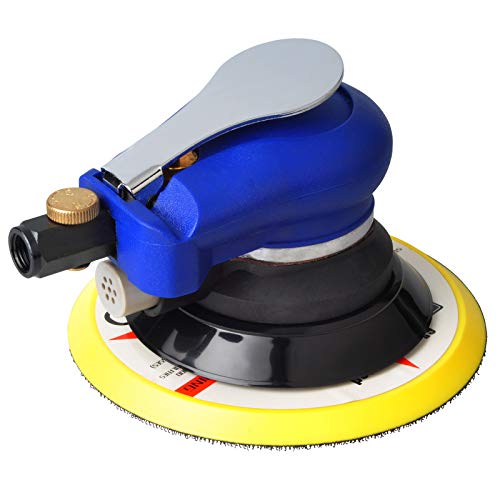
The PROSHI 6-inch air sander makes sense for a shop that already runs pneumatic tools, because the 6-inch face covers more surface with each pass. That larger pad can feel a bit much for tiny furniture parts, but it helps on panels and broader bodywork-style sanding.
Compared with the Bosch, this one is less about portability and more about workshop output. Hook-and-loop disc mounting keeps paper changes simple, which matters when you move through multiple grits in a single session.
Strong Points
- 6-inch pad gives you broader coverage on larger panels.
- Hook-and-loop face helps sanding discs swap quickly.
- Air-powered format suits shops that already rely on compressors.
- Works well for longer, repetitive sanding jobs where steady output matters.
Points To Note
- You need compressed air, so it is not a standalone home plug-in pick.
- The larger pad can feel less nimble in cramped corners.
- Air tool upkeep usually means a little more attention to hoses and fittings.
Feature Card
Who Should Grab It
Shop users with compressor access, especially anyone working on larger surfaces, will appreciate the straightforward air-tool setup.
Where A Sibling Pick Shines
WORKPRO 5-Inch Random Orbit Sander suits casual garage use better, because it plugs in and keeps the setup much simpler.
This Gedu 6-inch pneumatic sander is aimed at heavier sanding routines, especially where low vibration matters during longer stretches of work. In a busy shop, that steadier feel can reduce hand fatigue, though it still depends on a compressor and a tidy air setup.
It lines up well against the PROSHI model, but the broader description here points toward a more workmanlike dual-action approach. You may find that a larger body is less nimble for trim, yet that same size is useful on doors, panels, and other broad surfaces.
Upsides
- Low-vibration design helps keep the tool calmer in hand.
- Dual-action motion is suited to finish prep on larger workpieces.
- 6-inch format can speed up broad-area sanding.
- Good fit for repeat shop use where comfort matters.
Softer Spots
- Air-powered tools need a compressor and hose management.
- Its larger footprint can feel busy in tight corners.
- Air tool storage and cleaning take a little more discipline.
- The size is less friendly for occasional one-hand touch-ups.
Details At A Glance
Built With In Mind
Shop owners and serious DIYers with compressor access will get the most value from the larger format and calmer feel.
Swap It Out When
Metabo HPT SV13YST makes more sense for lighter finish work, especially where a plug-in electric body is easier to manage.
This Gedu air sander keeps the focus on the basics, which is useful in a workshop that wants a no-frills pneumatic palm tool. Compared with the 6-inch Gedu above, it is the simpler sibling, so the appeal here is straightforward handling rather than extra surface coverage.
That makes it a sensible match for shop users who already know their way around air tools and do not need a crowded feature list. The trade-off is that you still need the compressor setup, and that rules out casual use at a kitchen table or in a small apartment garage.
Highlights
- Dual-action pneumatic design suits controlled sanding passes.
- Compact palm style can feel familiar in regular shop use.
- Good fit for users who want air-tool simplicity.
Areas To Watch
- Requires air supply equipment, which adds setup steps.
- Lacks the broader surface coverage of the 6-inch Gedu option.
- Storage is easier than a bigger shop machine, but hoses still need a place to live.
Core Details
Whose Shelf It Belongs On
Experienced shop users who want a simple air-powered palm sander will find the fit easy to understand.
Look Elsewhere When
Bosch ROS20VSK suits you better for plug-in home projects, since it avoids the compressor requirement altogether.
The ONEAND cordless sander is for mobile work, plain and simple. On ladders, at a jobsite without easy power access, or out in the driveway, that cord-free setup saves you from dragging an extension lead across the floor.
Compared with the Bosch and WORKPRO plug-in picks, you trade away that constant plugged-in convenience for range and quick movement. One thing worth considering is that this is tool only, so you need the matching battery and charger from the same platform.
Positives
- Cordless design keeps movement easy around large projects.
- 5-inch size stays familiar and manageable in hand.
- Good choice for jobsite touch-ups and quick moves between spaces.
- Less cable clutter around stairs, porches, and workbenches.
Minor Gripes
- You need to supply the battery and charger separately.
- Runtime depends on the pack you already own.
- Tool-only packaging can add a little upfront planning.
Technical Sheet
Right Fit For
Mobile DIYers, remodel crews, and anyone who values cord-free movement will find this format useful.
Another Choice May Suit
WORKPRO 5-Inch Random Orbit Sander fits you better for plug-in garage use, especially when you want the simplest setup.
WORKPRO leans into versatility, with six speed settings and a 2.5 amp motor that make sense for a range of sanding jobs. For many garage projects, that spread is useful because soft woods, finish prep, and quick cleanup work often want different levels of touch.
Unlike the cordless ONEAND, this is a plug-in electric tool, so you get a simpler power story and no battery math. You also get a dust collector and 15 sanding sheets, which can make it friendlier for a first setup or a spare tool in the shop.
Bright Spots
- Six speed settings help you match the tool to the surface.
- 2.5 amp motor gives you a clear electric sanding setup.
- Dust collector helps keep cleanup more manageable.
- Fifteen sanding sheets add convenience for new projects.
- Strong fit for general home woodworking without extra complexity.
Room For Improvement
- Corded use can still limit movement across larger spaces.
- Dust collection works best with regular emptying and cleanup.
- The included sheet count helps, but recurring projects will still need more abrasives later.
Feature Rundown
Who Will Love This
Home woodworkers and casual fix-up shoppers who want a practical electric sander with useful extras will like the balance here.
Where A Sibling Pick Shines
Bosch ROS20VSK suits you better for a smoother palm feel, especially when you want a more familiar all-purpose sander shape.
The Autolock air sander stands out because it includes extra backing plates, which makes it more adaptable than the more fixed-feeling pneumatic picks above. That matters in a shop where you may shift between different disc sizes for wood, composites, or metal prep.
Compared with the PROSHI and Gedu air tools, this one is the more flexible-sounding choice for mixed surfaces. The trade-off is the usual pneumatic one, you still need compressor support, so it fits shops better than small apartments or quick countertop repairs.
Best Bits
- Extra 5-inch and 6-inch backing plates add useful flexibility.
- Dual-action pneumatic setup suits workshop sanding routines.
- Helpful for users moving between wood, composites, and metal.
- Plate variety can reduce the need for a second air sander.
Small Caveats
- Compressor access is still part of the equation.
- Air hoses and fittings need regular attention in storage.
- The added parts help with versatility, but they also mean more pieces to keep track of.
Feature Snapshot
The Right Fit
Workshop users who want one air sander with more plate flexibility will appreciate the range here.
Reach For A Different Pick When
WORKPRO 5-Inch Random Orbit Sander suits you better for simple plug-in work, especially where you do not want to manage air gear.
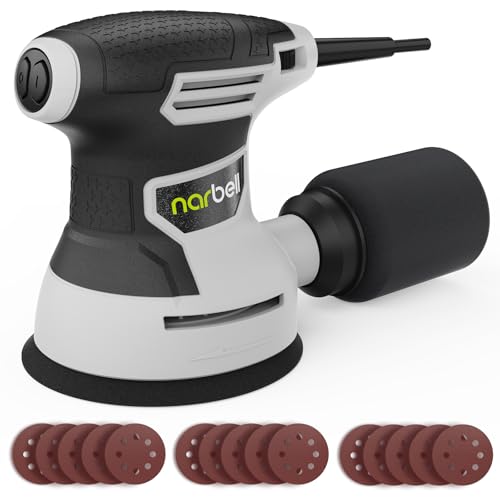
The NARBELL kit leans into a fuller starter bundle, with a 3.0 amp motor, six speeds, a dust bag, and 15 sanding sheets in the mix. For hobby furniture work or light renovation tasks, that package can feel complete without asking you to assemble much on your own.
Against WORKPRO, this one looks a touch more kit-focused while keeping the same 5-inch home-shop scale. The honest read is that the dust bag and included abrasives will appeal to people who want a ready-to-use box, though serious shop users may still prefer a stronger dust hookup.
Strong Points
- 3.0 amp motor gives the tool a solid electric base.
- Six speed settings support different sanding tasks.
- Dust bag helps reduce debris around the work area.
- Fifteen sanding sheets add starter convenience.
- Well suited to hobby work and routine finishing.
Worth Noting
- Dust bags usually need more attention than a more complete collection setup.
- The included sheets are helpful, but regular sanding still burns through consumables.
- Best fit stays around home and hobby use rather than heavy shop pace.
At A Glance
Perfect Match For
DIYers who want a starter kit with useful extras and a familiar 5-inch format will find the NARBELL easy to place in the shop.
Skip It When
Metabo HPT SV13YST is the better call for finish-focused work, since its comfort grip and defined speed range suit more refined sanding.
Metabo HPT keeps this one focused on comfort and finish work, which is exactly where a palm-style grip earns its place. The 9,000 to 13,000 RPM range gives you a defined operating window, and the dust hose connector makes sense in a shop that wants cleaner air around the bench.
Compared with the Bosch, it feels more tuned to finishing discipline than general-purpose polish duty. For cabinets, trim, and touch-up sanding, that narrower focus is a strength, though larger removal jobs may call for a more aggressive or larger-pad tool.
Reasons To Buy
- Palm-style comfort grip helps with control during longer passes.
- Variable speed range supports careful finish sanding.
- Dust hose connector suits a tidier shop setup.
- Compact, lightweight design should feel manageable in regular use.
Honest Caveats
- Finish-focused tools are not the best answer for heavy stock removal.
- Hose connection helps with cleanup, but it still means one more setup step.
- The narrower speed window may feel more specialized than a broader all-rounder.
Quick Facts
Who Will Love This
Finish-minded DIYers and trim installers who want a lighter, more controlled sander will get a lot from this Metabo HPT model.
Where Shoppers Go Wrong
PROSHI 6-Inch Random Orbit Air Sanders make more sense for bigger compressor-fed shop tasks, especially where surface coverage matters more than a compact grip.
How To Choose The Right Random Orbit Sanders
Match Pad Size To The Work
Five-inch sanders are the safest all-around starting point for cabinets, trim, tabletops, and furniture repairs. Six-inch models cover broader panels more quickly, but that extra reach can feel awkward on narrow shelves or tight corners.
The pad size also changes how the tool feels in your hand. A smaller disc is easier to guide, while a larger one can save time on flat surfaces.
Choose The Power Style That Fits Your Space
Corded electric sanders suit garages and home shops where a wall outlet stays close by. Cordless models help on porches, ladders, and job sites, while air sanders make the most sense in compressor-equipped shops.
That choice shapes more than runtime, it changes noise, storage, and cleanup habits too. A cordless tool travels well, but it still depends on your battery platform.
Look Past Speed Numbers Alone
Variable speed matters because different surfaces ask for different pacing. Lower settings are handy for finish work, while higher settings help move through rougher prep faster.
RPM stands for revolutions per minute, and it’s a basic measure of how fast the pad turns. Higher numbers are not automatically better, since control and sanding grit matter just as much.
Think About Dust And Grip
Dust collection keeps the workspace easier to live with, especially for indoor projects and repeated weekend use. A hose connector or dust bag can help, though neither replaces regular cleanup.
Palm-style grips and lighter bodies also matter more than they sound. They help the tool feel steadier on vertical trim, door edges, and long finishing passes.
A Quick Reality Check
Common Shopping Slip Ups
Many people grab a tool that is too large for furniture or trim work. Others forget that air sanders need compressors, hoses, and storage space that plug-in models do not.
Disc size, speed control, and dust handling should all match the job, not just the product photo. A tidy setup usually saves more frustration than another accessory pack.
The Upgrade Payoff
Higher-tier models often cost more because they bring better grip comfort, cleaner dust handling, and more controlled speed ranges. Those details matter most during longer sessions, where a tool that feels balanced can save strain and keep the finish more even.
You also pay for stronger build quality cues like better connectors, sturdier housings, or more complete kits. That upgrade is worth it for frequent users, while occasional home sanding can stay with a simpler model.
Frequently Asked Questions
What Size Random Orbit Sander Works For Most Home Projects?
A 5-inch model is the most flexible place to start for furniture, trim, and general smoothing. It is small enough for control, yet broad enough to move through common jobs without feeling tiny.
Do Cordless Random Orbit Sanders Make Sense For Garage Use?
Cordless models are helpful when cords get in the way or outlets are far from the work area. They suit quick tasks and mobile jobs especially well.
Why Do Some Random Orbit Sanders Need Air Compressors?
Air sanders run on compressed air rather than electricity from the wall. That setup suits workshops already built around pneumatic tools.
Is Dust Collection Really Important On A Random Orbit Sander?
Yes, because sanding creates a lot of fine debris around the workpiece. A bag or hose connection helps keep the bench and floor more manageable.
What Makes A Finishing Sander Different From A General Random Orbit Sander?
A finishing sander is usually tuned for smoother final passes and lighter touch work. A more general random orbit model can handle a wider mix of prep and touch-up jobs.
Closing Thoughts
You have a clear path now, whether you want a simple plug-in palm sander, a cordless tool for moving around the house, or a pneumatic model for the shop. The right choice comes down to how much control, portability, and dust management you want in everyday use. Bosch and Metabo HPT make strong starting points for most home setups, while the air tools suit bigger, compressor-backed spaces. Pick the format that fits your workspace first, and the sanding feels easier from the start.