Choosing carving knives for woods comes down to the kind of work you actually want to do, from clean detail cuts to rough shaping and small starter projects. Some picks suit beginners who want a forgiving first set, while others make more sense for practiced hands working on hooks, curves, or tight corners. A few of these options are also kit-based, so you can start carving with the knife and the material in one go. The right match saves you from fighting the tool every time you sit down to carve.
Quick Look At The Shortlist

Hutsuls Wood Whittling Kit for Beginners
Morakniv Wood Carving Hook Knife 164

BeaverCraft Whittling Knife C2 6.5″

Basswood Carving Blocks 19PCS

BeaverCraft Wood Carving Kit Comfort Bird

BeaverCraft Wood Carving Sloyd Knife C4s 3″

Flexcut Wood Carving Tools Beginner Palm & Knife Set KN600

BeaverCraft Wood Carving Kit for Beginners S16
More Details On Our Top Picks
This kit fits the person who wants a gentler entry into carving without hunting for separate tools first. The gift-box presentation makes it feel organized right away, and that matters in a hobby where loose blades and spare parts tend to get scattered.
For a beginner at a kitchen table or craft desk, that ready-made structure can lower the friction of starting. The trade-off is that an all-in-one kit usually focuses on getting you moving, not on giving you the most specialized blade for every style of carving.
Strong Points
- Eight-piece setup covers a range of starter tasks.
- Gift box storage keeps the set easier to organize.
- Good match for new hands learning safe grip habits.
- Works well for casual carving sessions at home.
Things To Consider
- The kit approach can mean more overlap than a single-purpose knife.
- Storage stays tidy only when you return each piece to the box.
Feature Snapshot
Who It Suits Best
New hobby carvers who want a neat starter set for home practice will get the most from it.
A Better Fit Elsewhere
Flexcut Wood Carving Tools Beginner Palm & Knife Set KN600 suits you better when you want a more tool-forward setup with a stronger control feel in the hand.
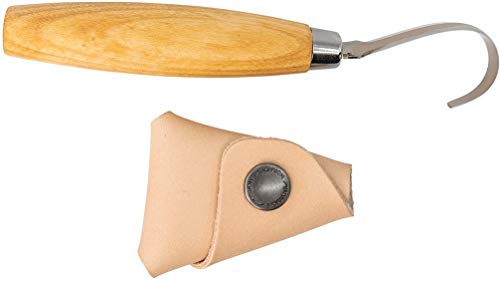
Hook knives change the job completely, because the curved edge is built for hollowing rather than straight slicing. For spoon, bowl, and ladle work, that shape feels much more natural than forcing a standard blade to do curved cuts.
The right-handed and left-handed sheath options matter too, since hand orientation is not a small detail in this category. You may find the learning curve a little steeper than with a straight whittling knife, but that’s the trade you make for cleaner hollow shapes.
What We Like
- Hooked blade shape suits hollow forms and rounded interiors.
- Right- and left-handed sheath options help with hand fit.
- Single-purpose design can feel more natural for spoon carving.
- Useful for carvers who already know their project style.
Small Caveats
- It does not replace a straight knife for general whittling.
- The curved profile asks for more technique and patience.
Details At A Glance
Built With In Mind
You will appreciate it most for spoon makers and bowl carvers who spend time on curved interiors.
Where A Sibling Pick Shines
BeaverCraft Wood Carving Sloyd Knife C4s 3″ fits you better when you need a straighter blade for shaping and roughing before detail work starts.
This one leans toward detail work, especially where a thin pointed tip helps you trace small shapes or clean up edges. Compared with the hook knife above, it makes much more sense for line control and delicate cuts than for hollowing rounded cavities.
The carbon steel blade and very sharp edge are the kind of features that matter most when you want smooth, clean slices on small workpieces. The honest read is that a fine edge asks for respect and maintenance, so it suits steady hands more than rushed carving sessions.
Upsides
- Thin pointed tip helps with delicate carving lines.
- Compact shape suits small blocks and fine details.
- Carbon steel construction fits frequent sharpening routines.
- Good bridge between beginner use and more exact work.
Areas To Watch
- The fine blade calls for careful handling during use and storage.
- It favors detail cuts, so larger shaping jobs need a different knife.
Core Details
Right Fit For
Detail-focused hobby carvers and chip carving beginners will get the clearest use from it.
Not Your Match When
Morakniv Wood Carving Hook Knife 164 is the better choice for spoon and bowl shaping that needs a curved cutting path.
Carving knives are only half the story, and this basswood block set fills the part many starter kits miss. Basswood is a soft carving wood, so it gives you a friendlier surface for learning cuts, shaping corners, and practicing clean passes without fighting hard grain.
The mix of rectangle and cube sizes makes it easier to match a block to a project instead of forcing one awkward piece to do everything. For a craft table that sees lots of practice sessions, the smooth, low-grain surface is a real comfort, though you still need to store the blocks where they stay dry and flat.
Bright Spots
- Nineteen pieces give you plenty of practice stock.
- Three size formats support different carving exercises.
- Soft basswood helps beginners learn with less resistance.
- Smooth surfaces make prep work simpler before carving starts.
Room For Improvement
- You still need knives, so this is a material bundle rather than a full carving kit.
- Wood blocks need sensible storage to avoid warping or damage.
Feature Rundown
Whose Shelf It Belongs On
Beginners who want practice wood on hand, plus hobby carvers who work through a lot of small projects, will use it most.
Swap It Out When
BeaverCraft Wood Carving Kit for Beginners S16 is the better fit when you want knives and basswood together in one starter bundle.
This kit is built around the Comfort Bird idea, which makes it feel more personal than a plain knife set. The project angle matters for people who want a small finished piece with a clear shape, rather than a pile of random practice cuts.
For adults learning a new hobby, or for a shared craft session with kids, that built-in direction can take away some of the blank-page feeling. The trade-off is straightforward, though, because a project kit gives you focus at the cost of variety.
What We Like
- Project-led format gives your first carving session a clear goal.
- Works well for gift-making and hobby time alike.
- Suitable for adults and kids who want a guided start.
- Comfort Bird concept helps the kit feel more meaningful.
Honest Caveats
- Project-specific kits narrow your options compared with open-ended sets.
- You may want a separate general-purpose knife later on.
Spec Overview
Made For
Beginner hobbyists who want a guided project and a more personal finished piece will connect with it fastest.
Another Choice May Suit
Hutsuls Wood Whittling Kit for Beginners is the broader pick when you want more of a general starter set instead of one themed project.
A sloyd knife sits in the sweet spot between rough shaping and careful cuts, and that long narrow blade with a curved point explains why. Compared with the C2 detail knife, this one gives you more reach and more confidence for shaping transitions, especially in tighter areas that still need a steady edge.
The 1066 high-carbon steel blade is the kind of material choice that usually appeals to people who carve often, because edge retention matters once a knife sees regular use. The leather sheath is also a practical touch for storage, though leather gear tends to reward a little care so it stays in good shape.
Reasons To Buy
- Long, narrow blade handles roughing and shaping well.
- Curved point reaches into tighter carving zones.
- High-carbon steel suits repeat use and sharpening cycles.
- Leather sheath adds a sensible storage layer.
Points To Note
- The blade shape still asks for control, especially near fingertips.
- Leather storage pieces need basic upkeep to stay usable.
Technical Sheet
The Right Fit
You will get the most from it as a carver who wants one knife for rough shaping, refining, and tighter interior cuts.
Skip It When
BeaverCraft Whittling Knife C2 6.5″ suits you better for more tip-driven detail work on smaller pieces.
Palm tools change how carving feels, because the shorter grip and shaped handle bring the work closer to your hand. The ashwood handles and 1095 high-carbon steel blades point to a kit built for control, which matters when you spend long stretches making careful cuts.
Compared with the starter kits above, this set looks better suited to someone who already knows the difference between a casual hobby session and a tool that rewards consistency. You may find the hand feel more secure for repetitive carving, though that tighter control usually comes with a bit less plug-and-play simplicity.
Highlights
- Palm-style format supports close, controlled carving.
- 1095 high-carbon steel blades suit frequent sharpening and use.
- Ashwood handles bring a more natural hand feel.
- Good step up for carvers who want more precision.
Minor Gripes
- Palm tools can feel less familiar to absolute beginners.
- The tighter grip style may not suit every hand size equally.
Feature Card
Best Suited To
You should gravitate toward it if you want a more controlled palm-tool setup for longer carving sessions.
Look Elsewhere When
BeaverCraft Wood Carving Kit for Beginners S16 is the easier starting point when you want knives plus basswood in one beginner bundle.
This is the broadest starter bundle in the group, because it combines knives with basswood blocks for practice right away. That matters for someone who wants to begin carving without spending a second round of time choosing separate material and tools.
The ergonomic handles are the real selling point in daily use, especially during longer sessions where grip comfort can shape how long you keep going. It’s not the most specialized path, but for many first-time carvers that balance is exactly the point.
Best Bits
- All-in-one format lowers the barrier to starting.
- Basswood blocks give you practice material from the start.
- Ergonomic handles help reduce hand fatigue over time.
- Good match for people who want a broad starter setup.
Worth Noting
- Starter bundles can leave you wanting more specialized blades later.
- More pieces mean a little more sorting and storage.
Core Details
Perfect Match For
New carvers who want a broad starter kit for home practice will get the most use from it.
Another Choice May Suit
Flexcut Wood Carving Tools KN600 is the stronger follow-up when your priority shifts toward a more control-focused palm-tool setup.
How To Choose The Right Carving Knives For Woods
Match The Blade To The Cut
Straight blades suit whittling, chip carving, and general shaping, while hook knives handle bowls, spoons, and other curved interiors. A sloyd blade sits between those two ideas, so it works well for roughing and shaping before detail work begins.
That distinction matters more than brand names or fancy packaging. The wrong blade shape turns a simple project into hand strain, while the right one feels like the tool is following the grain instead of arguing with it.
Think About Grip And Control
Palm knives, fuller handles, and ergonomic shapes help on longer sessions because they keep the knife settled in your hand. A compact tool can feel precise, but it may ask for more attention during longer cuts or repetitive shaping.
Beginners usually do better with a grip that feels stable and easy to orient. Experienced carvers often want a handle that disappears into the task, not one that calls attention to itself.
Choose Material Around Maintenance Habits
High-carbon steel shows up often in this category because it can support a keen edge for repeat use. The trade-off is simple, because sharper edges also ask for more careful storage and periodic upkeep.
Basswood, leather sheaths, and gift-box storage each solve a different part of the ownership puzzle. One helps the blade cut more easily, another protects the edge, and the third keeps the kit from becoming clutter.
Build Around Your First Few Projects
Starter kits work best when you want guided practice, while standalone knives make more sense once you already know your carving style. If you plan to make spoons or bowls, a hook knife belongs near the top of the list. For small figures and detail cuts, a pointed whittling knife usually gets more use.
The simplest path is often the smartest one: choose the tool that matches the project you’ll actually sit down to finish. That keeps the hobby enjoyable instead of turning every session into setup work.
Things Worth Knowing First
Mistakes Worth Dodging
Many shoppers start with a blade shape that sounds versatile but doesn’t match the project they want. A detail knife won’t hollow a bowl cleanly, and a hook knife won’t replace a straight whittling blade.
Another common slip is ignoring storage. Bare blades, loose blocks, and unmarked parts create clutter fast, so sets with sheaths or boxes often make daily use easier.
What The Higher Tier Buys
More expensive carving tools often use better steel, more comfortable handles, or tighter finishing on the edge and sheath. That usually shows up as smoother control, less hand fatigue, and a tool that feels more settled during repeat sessions.
The upgrade makes sense when carving has already become a regular habit. For occasional hobby use, a simpler kit may be enough, but frequent carvers often notice the comfort difference right away.
Frequently Asked Questions
What should you look for first in carving knives for woods?
Start with blade shape, because that decides the kinds of cuts you can make comfortably. After that, look at handle comfort and whether the set includes the practice wood or accessories you need.
Is a starter kit better than a single knife?
A starter kit helps when you want a guided first step and don’t want to source separate pieces. A single knife suits you better once you already know your project style and want a more focused tool.
Why do some carving knives use high-carbon steel?
High-carbon steel is common because it can take a fine edge for detail work and repeated shaping. The trade-off is that the knife rewards more attentive care and storage.
Do you need basswood for learning?
Basswood is a very practical practice wood because it carves more easily than harder stock. It gives new carvers a friendlier surface while they learn grip, grain direction, and basic cuts.
Which knife style works best for spoons and bowls?
A hook knife is the most natural fit for hollowing spoon bowls and similar rounded spaces. Straight whittling knives are better for edges, chips, and outer shaping.
Final Thoughts
The right carving knife for woods depends less on hype and more on the kind of work you want on the bench. Hutsuls and BeaverCraft starter kits make sense for easy entry, Morakniv and the sloyd style handle more specialized shaping, and Flexcut suits a more control-minded hand. If you choose around blade shape, grip comfort, and your first few projects, you’ll end up with a tool that earns its place instead of sitting in a drawer. That’s usually the difference between a hobby you return to and one you only meant to start.