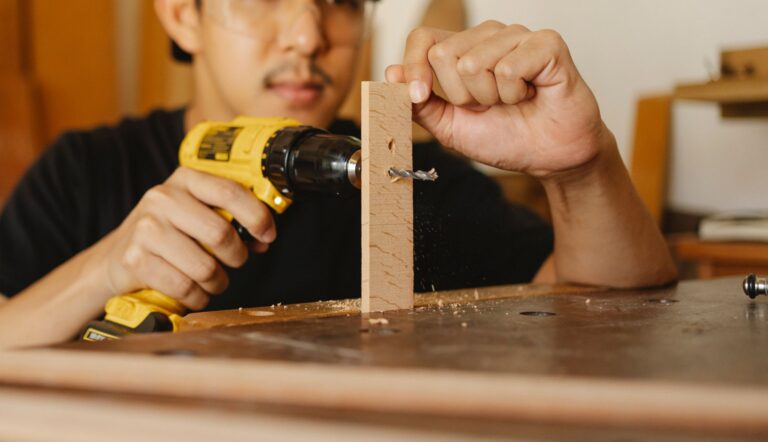
Circular saw vs table saw is a choice between a moving blade and a fixed station. A circular saw travels to the material, which helps with plywood, framing, and driveway cuts. A table saw keeps the blade in place, so you feed stock through a rigid setup for steadier rip cuts and repeatable sizes.
This guide compares two staple woodworking tools so a first-time buyer can choose confidently, weighing accuracy, portability, shop space, safety, and overall value before making a purchase.
The Two Saws, The Two Workflows
A circular saw rides on top of the workpiece, so you bring the tool to the cut instead of moving a full sheet around a machine. That matters when you are breaking down 4 x 8 plywood, trimming deck boards, or cutting where the stock already sits on sawhorses.
A table saw stays fixed, with the blade rising through the top and the rip fence guiding the material past the cut. That layout makes the cut path more predictable, which is why batch work and square sizing feel faster once the machine is set up.
- Portable cutting: A circular saw moves to the material, so you can work in a garage, driveway, or jobsite.
- Fixed station: A table saw keeps the blade in one place while you feed stock across the top.
- Setup style: One tool asks for clamps and a straightedge, while the other asks for fence alignment and workpiece support.
- Workflow result: The handheld tool favors flexibility, and the stationary tool favors repetition.
Blade depth, motor path, and work support shape the whole experience. A circular saw feels closer to layout and marking, while a table saw feels closer to production and sizing. That split drives the circular saw vs table saw decision, and it leads straight into accuracy because workflow and precision are tied together.
That same workflow difference also explains why precision becomes the real test of each saw.
Accuracy, Repeatability, And Cut Quality
That workflow split shows up most clearly at the cut line. A table saw gives you steadier repeatability because the miter gauge and rip fence guide the stock through the blade at a fixed angle, which helps with shelves, cabinet sides, and other matching parts.
A circular saw can still make straight cuts, but the result depends on the guide you clamp down and the support under the board. A long rip on plywood can come out clean, yet small hand drift can show up by the end of the cut, especially on a 6-foot run.
| Cut task | Circular saw | Table saw |
|---|---|---|
| Straight sheet cut | Strong with a straightedge or track guide | Possible, but awkward on a full sheet |
| Rip cut | Works with a guide, slower to repeat | Strong, fast, and easy to repeat |
| Crosscut | Good with a square and solid support | Good with a miter gauge or sled |
| Bevel cut | Easy to set at the shoe | Possible, but less convenient for frequent angle changes |
A table saw can do one thing a circular saw cannot match well: produce the same width over and over with almost no layout drift. That repeatability is why cabinet shops rely on fences, sleds, and stop blocks, and it is also why the table saw vs circular saw for woodworking choice changes once your projects move from one-off cuts to matching parts.
Once cuts have to match, the question shifts from raw accuracy to whether your shop can support it.
Portability, Space, And Setup Realities
That precision only matters if the saw fits your space. A circular saw wins the portability race by a wide margin, since you can carry it in one hand and start cutting on sawhorses without clearing half the garage.
A table saw asks for floor space, infeed room, and outfeed room. A 4 x 8 sheet of plywood needs room before and after the blade, so the footprint of the saw is only part of the space it consumes.
| Practical factor | Circular saw | Table saw |
|---|---|---|
| Transport | Fits in a tote or tool bag | Needs a stand or dedicated spot |
| Storage | Small shelf or cabinet space | Bigger footprint, even for compact jobsite models |
| Setup time | Clamp guide, mark line, cut | Set fence, check alignment, clear feed path |
| Working area | Works well in tight spaces | Needs room before and after the blade |
That space gap matters more than the box label on the saw. A tool you can lift gets used on a Tuesday night repair, while a machine that needs a cleared path usually waits for larger woodworking projects. Cost sits in the same category of real-world friction, because the first purchase is never just the saw.
Those constraints make price feel less like a number and more like the start of a long-term tradeoff.
Cost, Value, And The First-Buy Decision
Entry pricing leans toward the handheld tool, and the hidden costs stay lighter too. A circular saw often needs only a good blade, a straightedge, and a couple of clamps, while a table saw can add a stand, a fence upgrade, a crosscut sled, and extra workpiece support.
For a low-budget home project, the circular saw makes sense as a starter because it covers framing, rough shelving, deck boards, and sheet breakdown with a small cash outlay. For a long-term shop setup, the table saw becomes smarter once you care about repeated widths, square edges, and parts that need matching from batch to batch.
A simple choice path helps here. Start with your space, then your project mix, then your patience for setup. Garage and driveway work point toward the handheld tool, while a corner shop with steady furniture or cabinet work points toward the stationary tool.
- Small space: Pick the portable saw and use sawhorses or foam board for support.
- Mixed DIY tasks: Pick the circular saw, then add guides as your cuts demand more control.
- Repeat parts: Pick the table saw, since identical widths are faster to produce.
- Cabinet-style work: Pick the table saw sooner, because fences and sleds shorten layout time.
That decision gets sharper once safety enters the picture, because a cheap setup is no bargain after a bad cut. Setup errors, unstable support, and rushed feeding cause more trouble than the logo on the tool housing, and that is where which saw is better for beginners starts to depend on your habits more than the spec sheet.
Even with a smaller budget, the bigger issue is how comfortably you can control the tool.
Safety, Control, And Learning Curve
A hand-held saw asks you to control the blade path, the cut line, and the support under the board at the same time. That juggling act is why a loose offcut or a sagging panel can turn a simple rip into a crooked cut.
A table saw shifts the risk into kickback, fence alignment, and hand position near the blade. The workpiece moves past a fixed cutter, so a bind or a crooked push can send stock back at speed, especially with wet lumber, warped boards, or a misaligned fence.
Keep the blade guard in place, support the stock, and slow the feed when the motor starts to labor. Rushed pressure is where most beginner mistakes start, and the wrong feed angle can matter more than the saw model.
Kickback is a physics problem, not a mystery. The spinning teeth lift fibers and push force back through the stock when the wood pinches the blade, and that stored energy can launch the board toward you. A riving knife, a splitter, and proper fence alignment reduce that binding by keeping the kerf from closing behind the blade. Brands such as SawStop and DEWALT build this thinking into safety-focused and jobsite models, and that lines up with common shop practice.
The handheld saw has its own learning curve. Sawing on the waste side of the line, bracing the sheet on both sides of the cut, and keeping the shoe flat all make a real difference. Stable support matters as much as hand strength, because a panel that sags halfway through the pass can shift the blade angle and spoil the cut.
Poor control shows up fastest when long stock begins to flex under its own weight.
Which Projects Each Saw Handles Best
Sheet goods in place push you toward the circular saw. Plywood, OSB, and deck boards are easier to manage when the tool travels to the material, especially on a driveway or a rough jobsite where the stock is too large for a fixed top.
Lumber sizing pushes you toward the table saw. A rip fence turns rough stock into matching parts, and that is why shelves, cabinet rails, face frames, and shop jigs fit the stationary tool so well.
Circular Saw Projects That Fit The Tool
- Framing cuts: Studs, plates, and joists are quick to size on sawhorses.
- Decking work: Long boards and field cuts stay manageable outside the shop.
- Trim prep: Rough length cuts come fast before finish trimming at the wall.
- Large panels: Full plywood sheets stay easier to handle before final sizing.
Table Saw Projects That Fit The Tool
- Rip cuts: Long boards can be trimmed to the same width over and over.
- Cabinet parts: Side panels, stretchers, and shelves need repeatable dimensioning.
- Joinery prep: Rabbets, dados, and clean edge prep sit naturally in a shop setup.
- Batch work: Repeated parts move faster once the fence is set.
Material choice matters too. Rough lumber can move and cup as it dries, so a table saw gives you a better shot at turning warped stock into useful parts after one straight reference edge exists. Oversized panels, on the other hand, are easier to break down with the handheld saw before they ever touch the stationary saw.
A steady reference edge changes everything, especially when a full sheet is too awkward to bring to the machine.
Getting Table-Saw-Like Results From A Circular Saw
A straightedge turns the handheld tool into a much cleaner cutter. Clamp a factory edge, an aluminum guide, or a track-style rail to the sheet, then run the saw shoe against that guide so the blade follows one fixed line.
That method works well for closet panels, shelf blanks, subfloor patches, and any job where the sheet is too large to feed through a fixed machine. The cut can come surprisingly close to table-saw control when the sheet is flat, the clamps stay out of the blade path, and the waste side has support.
- Mark once: Lay out the line clearly and account for blade width before clamping a guide.
- Clamp tight: Fasten the straightedge so the saw shoe cannot drift under load.
- Support both sides: Keep the panel level so the kerf does not pinch near the end.
- Finish with control: Let the blade clear before lifting the saw from the cut.
That setup can stand in for a table saw on many home tasks, but it cannot match the repeatability of a fence-driven machine for production work. A circular saw can copy part of the workflow, yet it still asks you to reset the guide for every line, which is why circular saw vs table saw for DIY projects often comes down to whether you are breaking down one sheet or building the same part ten times.
That difference matters most when the job shifts from single cuts to repeated parts with identical dimensions.
Owning One Saw, Then Adding The Other
A homeowner who cuts trim, shelves, or the occasional deck board can do a lot with a circular saw alone. Add a straightedge, a good blade, and a pair of sturdy horses, and you can handle most rough dimensioning without crowding the garage.
A table saw becomes the smarter second purchase once your work shifts toward furniture parts, cabinet cases, and repeated rip cuts. At that point, the fence, miter gauge, and sled options save time on every batch of parts, and the fixed setup makes square work easier to repeat.
A circular saw blade should not be swapped onto a table saw. The arbor size, tooth geometry, intended feed direction, and chip removal all matter, and the saw body is built around different blade loads and blade guard geometry. A blade made for the handheld tool belongs on that tool, not on the stationary machine.
Used together, the two tools make a tidy pair: one breaks down large stock, and the other brings parts to final width with cleaner consistency. That combination is why many garages start with the portable saw, then add the table saw only after the projects grow past rough cuts and simple repairs.
That progression is why many shops begin with one saw and only expand when routine work demands it.
Bottom Line
Portability points toward the circular saw, repeatability points toward the table saw, and your workspace decides how much either advantage matters. A tight garage, shared driveway, or occasional weekend project usually favors the handheld tool, while a fixed shop, batch work, and cabinet-style cuts tilt the choice the other way.
That split is the clearest way to think about circular saw vs table saw before you spend the money. You can start with one tool, cover most early cuts, and add the other when your projects begin asking for the missing strength.
FAQ
Can you use a circular saw as a table saw?
With a straightedge, clamps, and solid work support, a circular saw can handle some table saw jobs surprisingly well. The catch is repeatability, since you reset the guide for each cut and still manage the panel by hand.
What can a table saw do that a circular saw can’t?
A table saw can rip boards to the same width again and again with a fence or sled. That fixed setup also helps with controlled batch work, which matters for shelving, cabinet parts, and other matched pieces.
Can you do woodworking with just a circular saw?
Framing, plywood breakdown, shelving, and rough sizing are all within reach when a circular saw is your only cutting tool. Fine joinery and repeated parts take more effort, so layout and support become part of every cut.
Which saw is better for beginners?
The better starter depends on your space and project mix. A circular saw fits small areas, costs less, and handles more job types outside a shop, while a table saw suits repeatable parts once your cutting routine settles down.
Which saw is safer for DIY projects?
Safety depends on setup, support, and feed control as much as tool type. A circular saw keeps the blade near your hands, while a table saw raises kickback risk, so both tools demand careful guarding and stable stock.
How do you make straight cuts with a circular saw?
Clamp a straightedge or track-style guide to the workpiece, keep the shoe flat, and support both sides of the cut. A sharp blade and steady feed help the saw follow the line without wandering.