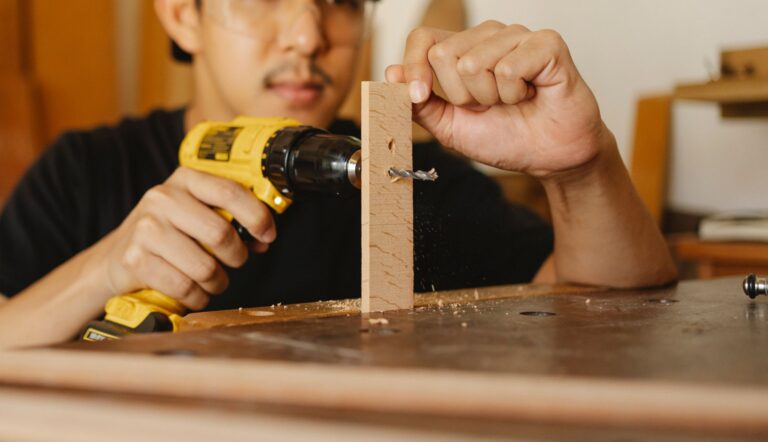
Router vs laminate trimmer is a choice about size, power, and control. A laminate trimmer refers to a compact router built for shallow cuts and edge work, while a full-size router is the larger tool you use when the bit needs more depth, torque, and stability.
You can use this comparison to sort out cabinet trim, shelf edges, laminate cleanup, and deeper woodworking cuts without guessing at the label on the box.
The Practical Difference Between The Two Tools
The name matters less than the cut in front of you. A laminate trimmer, trim router, and palm router often describe the same compact family, so base style, motor size, and bit exposure usually matter more than the marketing term.
A full-size router brings more torque and reach, which changes what you can cut in a single pass. That extra capacity matters for dadoes, mortises, pattern work, and larger profiles, while the smaller tool feels right when the edge is narrow and your hand needs finer control.
For router vs laminate trimmer, the real question is the workpiece. Edge trimming on melamine or plastic laminate asks for a compact tool that stays out of the way; a raised-panel door or deep slot asks for a larger machine that stays steady under load.
Where the names overlap
Laminate trimmer and trim router are often used for the same compact tool category. Palm router is another common name, and it points to the same basic advantage: one-hand control on small jobs.
That overlap explains a lot of shopping confusion. Some trim routers are little more than laminate trimmers with nicer bases, while others sit closer to a mid-size compact router with better depth control and a stronger motor.
Why the task matters more than the label
A laminate edge can chip fast under a heavy cut, so the lighter tool often gives you cleaner results. A wide mortise or 1/2-inch roundover bit changes the picture because the larger router carries the bit more calmly and accepts more aggressive work.
Router bit diameter, shank size, and base opening all shape the result. That is why the right choice depends on the cut path in front of you, and the next section shows how body size changes control in your hands.
That same reach also changes how much leverage you feel, which is where hand comfort starts to matter.
Size, Weight, And One-Hand Control
The smaller body wins the moment your cut starts on a cabinet face or a narrow shelf edge. Less weight means less wrist fatigue, and the base stays easier to register against the work without tipping off the edge.
A full-size router feels calmer on broad stock because its mass resists chatter. That steadiness helps on long passes, especially along a straightedge or template where any wobble shows up as a wavy line.
| Handling Factor | Laminate Trimmer | Full-Size Router |
|---|---|---|
| Weight | Light enough for one-hand edge work | Heavier, steadier on larger panels |
| Control | Easy to steer on narrow trim and shelves | Better when both hands can guide the cut |
| Fatigue | Lower strain during short trim jobs | More tiring overhead or on vertical surfaces |
| Feel at the edge | Less drag and less chance of tipping | Stable, but bulkier near a finished edge |
Vertical surfaces expose the difference fast. Trimming a veneer edge on a cabinet side demands quick correction and a light touch, and the compact tool gives you both. A heavy router can still do the job, but your grip has to work harder to keep the base flat.
On broad stock, that extra heft turns into an advantage. The larger router tracks well on a tabletop or door blank, and that steadiness matters once the bit starts pulling through a long grain line.
Extra weight can steady a cut, but it also makes tight, one-handed control harder to sustain.
Power, Depth, And Bit Capacity
Motor output sets the ceiling for how much material you can remove before the tool starts to complain. A laminate trimmer has less reserve, so it excels at shallow cuts, while a router can push larger bits through thicker hardwood with less strain.
Depth capacity follows the same pattern. The larger tool reaches farther below the base, which matters for dadoes, mortises, and wider profiles where the cut must start deeper in the stock.
Shank size and collet fit
A secure fit depends on matching the collet to the shank diameter. Many laminate trimmers accept 1/4-inch shank bits only, while a full-size router often takes 1/4-inch and 1/2-inch shanks, which opens the door to stiffer bits and heavier cuts.
That extra shank size matters because a thicker shank flexes less under load. Less flex means a cleaner cut in dense wood and less chatter when the bit sticks farther out of the base.
What deeper cuts demand
Routers handle more aggressive joinery because the motor can hold speed under load. Deep dados, large roundovers, and template work with a guide bushing all ask for power that stays steady instead of sagging halfway through the pass.
A plunge router adds a separate advantage, since the bit can enter the material from above without a starter hole. That feature matters in mortises and inlays, and it becomes the better choice once the cut begins in the middle of a board rather than at the edge.
As soon as the work shifts inward from the edge, a compact body suddenly becomes a real advantage.
Where A Laminate Trimmer Earns Its Keep
Edge cleanup is where the small tool feels almost made for the job. Flush trimming laminate, leveling banding, soft chamfers, and light profile work all suit the lighter body because the cut is shallow and the contact area stays small.
Plastic laminate, edge banding, and thin hardwood strips can chip quickly under too much tool weight. The compact base helps you stay close to the edge without pushing the bearing or the bit into the finished face.
Best fits for the compact tool
- Laminate edging: A flush trim bit with a bearing trims laminate close to the substrate and leaves a neat edge for final sanding.
- Small chamfers: A 45-degree chamfer bit rounds a sharp edge just enough for hand feel without removing much stock.
- Light profiling: Small ogee or roundover bits work well on shelf fronts, drawer faces, and picture frames.
- Template cleanup: Thin patterns and small jigs stay easier to follow with a light one-hand tool.
Where the substitution stops
A laminate trimmer can do router work inside its limits, but those limits arrive fast on thick hardwood. Deep dados, wide rabbets, and heavy raised-panel bits ask for more torque than the compact motor can sustain.
Cabinet shops and field installers still keep both tools close because the smaller one wins on edge detail, while the larger router carries the load on structural cuts. That split becomes clearer once you move from trim work to joinery.
That difference matters most when the work turns from trimming veneer to cutting joinery that must hold.
Projects That Still Call For A Full-Size Router
Grooves, mortises, inlays, and template routing need more than a small motor and a tiny base. The larger machine gives you the cut depth, bit selection, and base stability that those tasks demand.
Dadoes are a good example. A straight bit cutting a shelf groove across plywood wants a rigid platform and enough power to stay at speed through the entire pass, especially near the end where grain direction changes.
Plunge capability changes the job
A plunge router starts cuts in the middle of stock without tilting the bit into the wood. That matters for mortises, sink cutouts, decorative inlays, and hinge recesses, where entry from the edge would leave the wrong path or a visible scar.
The plunge mechanism also helps with stop cuts. You lower the bit only where needed, lift it at the end, and keep the surrounding surface untouched.
Where the compact tool reaches its limit
Heavy accessories can overload a small body. Large guide bushings, wider bases, and bigger profile bits create drag that feels mild on a full router but awkward on a laminate trimmer.
The same limitation shows up in depth. Once the bit exposure gets long, the small motor has less room to breathe, and the cut can burn or wander. That is the point where the bigger machine earns its keep.
A light machine is handy for edge work, yet thin stock demands cleaner support to avoid damage.
Use the smaller tool for edge work and the larger one for bulk removal. That split keeps the cut cleaner and keeps your hands from fighting the tool.
Laminate Edging Without Tear-Out Or Burn Marks
Clean laminate work starts before the bit touches the edge. A sharp flush trim bit, a flat substrate, and firm base contact matter more than raw speed, because laminate chips and scorch marks show every mistake.
Feed direction changes the result as much as the bit choice. Move against the cutter rotation where the edge allows it, and keep the pass light enough that the bit slices instead of scraping.
Setup that keeps the edge clean
Set the bearing so it rides the substrate, not the finished face, and check that the laminate overhang stays even all the way around. Uneven overhang forces the bit to bite too deep in one area, which is where tear-out starts.
A straightedge or fence helps on long runs, especially on cabinet tops and wide panels. On short workpieces, a snug clamp line gives you more control than trying to freehand the whole length.
Cut direction and pass depth
Take shallow passes on brittle laminate. A deep single pass can grab the edge, heat the cutter, and leave a brown line that sanding will not fully remove.
Right-to-left travel across a standard outside edge often gives the cutter the cleanest bite. Inside corners need more caution because the grain or laminate layer can split where the bit exits the cut.
Safety and control on narrow stock
Keep two hands on the tool whenever the piece is wide enough for it. Narrow strips can twist under torque, and that twist can pull the cutter across the face faster than your grip can react.
Kickback risk climbs when the bit binds or the feed direction fights the cutter. A small tool feels light, but that same lightness makes it easier for the bit to yank the base off line, so steady pressure matters more than force.
Because the cutter is doing less of the work, the rest of the setup has to stay predictable.
Bits, Bases, And Accessory Choices That Matter
Bit choice sets the ceiling for both tools. A 1/4-inch shank flush trim bit is common in laminate work, while larger routers open the door to 1/2-inch shanks and bigger profile cutters that resist flex on longer passes.
Base options shape how the tool handles near an edge. A compact fixed base gives good control for trim work, while edge guides, offset bases, and plunge bases widen the range of cuts you can make with the same motor.
- Start with a flush trim bit. It handles laminate edging, banding, and most basic cleanup work.
- Add a straight bit. It covers dados, grooves, and simple shelf joinery in a larger router.
- Check shank size. A 1/4-inch collet fits many small jobs, while 1/2-inch adds stiffness on bigger cutters.
- Use an edge guide. It helps on repetitive cuts and keeps your line consistent.
- Skip oversized kits at the start. A stack of specialty bits sits unused until your projects call for them.
Kreg has helped make compact routers feel less like a novelty and more like a real shop tool, especially with guides and edge accessories. That matters because the base and guide system can change a tool from a trim-only machine into something far more useful.
A beginner often buys too many bits before learning which cuts show up week after week. Start with the cutters that match your stock and your joinery, then add profiles as your projects ask for them.
Those choices shape what the tool can do every day, especially when the same setup repeats across projects.
A Simple Buying Decision For Common Woodworking Tasks
Task choice beats brand hype every time. A laminate trimmer is enough for edge banding, shelf cleanup, and light chamfers, while a compact trim router makes sense once you want a little more power without giving up one-hand control.
A full-size router earns its place when you cut joinery, shape larger profiles, or rely on a plunge base. Budget, workshop size, and how often you use the tool all feed that decision, because a machine that fits your bench but not your project will stay in the case.
| Task | Best Fit | Why It Fits |
|---|---|---|
| Laminate edging | Laminate trimmer | Light weight and small base help with clean flush trimming |
| Small chamfers and light profiling | Laminate trimmer or compact trim router | Short passes need control more than raw torque |
| Dadoes and grooves | Full-size router | Better depth, power, and bit support |
| Mortises and inlays | Plunge router | Starts cuts inside the board with cleaner entry |
| Template work on larger stock | Full-size router | Steadier on broad panels and longer bit exposure |
For a small shop, a laminate trimmer plus a plunge router covers a lot of ground without crowding the bench. For heavier joinery, a full-size router becomes the better long-term tool because it handles the cuts that compact machines can only approach.
That balance makes the decision clearer: choose the tool that matches the jobs you actually repeat.
Wrap Up
The clean split is this: use the smaller tool for edge control and the larger router for reach, power, and accessory range. That choice keeps your cuts safer, your edges cleaner, and your tool set closer to the work you actually do. For router vs laminate trimmer, the project decides.
FAQ
Can I use a laminate trimmer as a router?
Yes, for shallow routing, light profiling, and edge cleanup. The limit appears with deeper cuts, larger bits, and heavy joinery, where the smaller motor and 1/4-inch collet reach their ceiling fast.
Can you cut laminate with a router?
Yes, and a flush trim bit is the common choice. Clean results depend on a sharp cutter, shallow passes, and a stable base, because laminate chips and burns faster than solid wood.
When should you use a trim router?
A trim router handles edge banding, shelf cleanup, light chamfers, and small profiling jobs. The light body stays easy to steer on narrow stock and finished panels.
What is the difference between a trim router and a full-size router?
A trim router is smaller, lighter, and better for one-hand control. A full-size router carries more power, accepts larger bits more often, and handles deeper cuts, template work, and joinery with more stability.
Is a laminate trimmer enough for edge trimming without tear-out?
Yes, with the right setup. Sharp bits, shallow passes, correct feed direction, and firm base contact do more for edge quality than motor size alone.