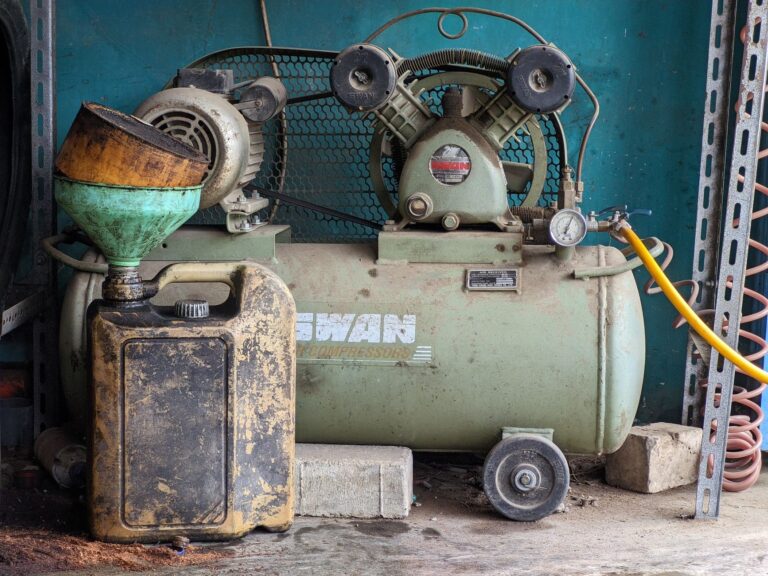
For repeated or heavy use, an oil-lubricated unit usually lasts longer because the pump stays cooler and wears more slowly. An oil-lubricated air compressor uses oil to reduce friction, heat, and piston wear, while an oil-free air compressor relies on coated parts and sealed bearings for cleaner compressed air and simpler maintenance requirements.
This article covers the practical tradeoffs between oil-lubricated and oil-free compressors, helping shop owners, contractors, and DIY mechanics judge performance, upkeep, air quality, and long-term costs for their work.
The Core Difference Behind Both Designs
The pump is where the decision starts, because the air compressor pump handles heat, friction, and wear on every stroke. Lubrication changes how hard those parts rub against each other, and that directly affects output stability.
In an oil-lubricated unit, oil coats the piston, rings, bearings, and other moving surfaces so friction stays lower during long runs. Oil-free designs use coated cylinders, special piston rings, low-friction materials, and sealed bearings instead of an oil bath, which reduces carryover but changes how the pump wears.
How lubrication changes wear and heat
Heat is the main stress point in compressed air systems, especially during long duty cycles. A cooler-running pump keeps seals from hardening as fast, slows metal expansion, and helps clearances stay stable, which is why lubrication matters when you run tools for hours.
An oil-free compressor can work well for lighter use, but its dry-running parts operate closer to their thermal limit. As the piston skirt, rings, or bearings wear, compression drops and noise rises, and that is when maintenance requirements start affecting the purchase decision.
What the label does not tell you
The sticker on the tank never tells the whole story. Two machines with the same horsepower can behave very differently because pump design, duty cycle, and build quality matter as much as the oil vs oil-free air compressor label.
Think of the label as a starting point. Your air needs, runtime, and work environment decide which design earns its place in the shop.
That tradeoff matters most where durability and frequent cycling outweigh a spotless air stream.
Where Oil-Lubricated Compressors Still Make Sense
Long runs are where lubrication pays off most clearly. A machine that cycles for nailers, framing work, fabrication, or repeated tool use benefits from lower friction and steadier heat control, and that usually shows up as calmer operation and longer service life.
Oil-lubricated models also tend to cost less upfront than oil-free units with similar output. That lower entry price matters when you want more compressor for less money, especially for a garage setup or a small shop that needs output more than portability.
Why longer duty cycles favor oil
Repeated starts and stops create heat spikes, and oil helps buffer those spikes inside the pump. Fluid-Aire Dynamics notes that oil carryover is separate from mechanical wear, which is why a lubricated pump can still be a smart choice even when downstream filtration handles air quality.
That distinction matters in body shops, cabinet shops, and fabrication bays. You may accept extra upkeep there because the pump stays cooler and the parts usually hold up longer under pressure.
The upkeep trade-off you take on
- Oil changes keep internal friction down and help the pump shed heat.
- Filter checks catch contamination before it reaches the pump internals.
- Drain-cock care clears moisture that can corrode the tank and fittings.
- Inspection intervals help you spot leaks, loose belts, and tired seals early.
- Skipped service usually shows up as hotter operation and shorter pump life.
Quincy Compressor and C.H. Reed both discuss lubricated compressors in terms of service discipline for a reason. The design rewards attention, and the payoff is a tougher machine for frequent use.
When uptime matters, buyers often accept a cleaner design that asks less day-to-day attention.
Why Buyers Reach for Oil-Free Units
Clean air is the main reason oil-free compressors get attention. They reduce contamination risk in the compressed air stream, so less oil vapor reaches the hose, the tool, or the surface you are finishing.
That matters in food work, pharmaceutical packaging, medical spaces, and paint work. A spray gun will forgive a lot less than a framing nailer, and even a tiny oil trace can show up as fisheye, speckling, or finish defects.
Jobs that favor cleaner air
- Food handling areas need lower contamination risk around air-driven equipment and packaging stations.
- Pharmaceutical and medical work call for cleaner compressed air paths around sensitive processes.
- Paint spraying benefits from lower oil carryover, which helps protect the finish.
- Portable service work often favors lighter, simpler units for quick tasks.
- Small home shops may choose oil-free when upkeep time matters more than long run life.
What oil-free still asks from you
Oil-free does not mean care-free. Seals, bearings, valves, and wear parts still age, and the pump still needs drainage, filter attention, and inspection for heat damage.
Power & Motion describes non-lubricated compressors as a materials problem as much as a lubrication problem, and that is the useful way to think about them. The pump survives by managing friction in other ways, not by escaping wear altogether.
Because friction never disappears, ownership costs depend on how that wear is managed over time.
Maintenance, Repairs, and Real Ownership Costs
Purchase price gets the spotlight, but total cost of ownership tells a more useful story. An oil-lubricated air compressor may ask for oil changes, belts, filters, and occasional service, yet it can still cost less across years of steady use than a cheaper machine that wears out sooner.
Oil-free units reduce routine service, but they are not maintenance-free and they can be harder to rebuild. Once a dry-running pump loses compression, the repair path can be shorter and less forgiving than the service path for a lubricated design.
| Ownership factor | Oil-lubricated unit | Oil-free unit |
|---|---|---|
| Routine service | Oil changes, filters, drains, and inspection | Less routine service, still needs seal and bearing checks |
| Repair path | Parts and rebuild work are often more familiar | Wear parts can be less forgiving and harder to revive |
| Downtime | Service intervals may pause work, but failures can be slower | Less routine care, though pump wear can arrive sooner |
| Upfront price | Often lower for similar output | Often higher for similar output |
That table only works because ownership is not one number. The machine that asks for a quart of oil and a filter swap can still be the cheaper choice over time, especially in a garage or small trade setup that runs tools every week.
Those practical savings only matter if the machine also fits the noise, heat, and air demands of the job.
Watch the downtime, not just the sticker. A compressor that waits for parts for three days can cost more in lost work than one that needs a simple oil change every few months.
Air Quality, Noise, Heat, and Efficiency in Practice
Compressed-air quality is often defined by ISO 8573-1, which sets contamination classes for particles, water, and oil. That standard matters because a tool does not care about marketing language; it cares about what reaches the hose.
Oil carryover is lower in oil-free compressors, but filtration may still be needed for fine spray work and sensitive equipment. A lubricated machine can also meet demanding air-quality needs with the right dryers and filters, which is why the pump type is only part of the air-quality picture.
What oil carryover means at the tool end
That the trace amount of lubricant that escapes into the compressed air stream. In plain terms, it is the residue that can smear a finish, foul a valve, or add an unwanted film to a process line.
Ferguson and Quincy Compressor both frame this as an application issue, not a moral judgment on the machine. The right setup for your sprayer may need downstream filtration even with an oil-free compressor, because hose, tank moisture, and ambient dust still matter.
Noise and heat are design problems too
Nozzle hiss and pump knock are not the same thing, and the loudest unit in the room is not always the one with oil in it. Motor size, pump speed, fan design, housing thickness, and mounting all shape the noise level.
Heat follows the same rule. A well-built oil-free compressor can run acceptably cool for short cycles, while a poorly cooled lubricated pump can still overheat under strain, so the design class matters as much as the lubrication choice.
Efficiency varies with the whole build
Efficiency is tied to compression ratio, motor load, leakage, and duty cycle. The lubricant cuts internal drag, but it does not rescue a weak design with poor airflow or undersized parts.
A shop owner watching the electric meter will care about that more than the label on the pump. So the smarter comparison is oil-lubricated vs oil-free air compressor performance under your actual runtime, not in a vacuum.
A shop’s real-world load often tells a different story than brochure numbers do.
Choosing by Task, Space, and Duty Cycle
A small inflation job and a spray booth ask for different things. The inflator wants convenience, the sprayer wants clean air, and the framing crew wants steady recovery, so the right pick depends on the task in front of you.
Start with duty cycle. Intermittent use leaves room for oil-free convenience, while long or repeated work leans toward a lubricated pump that can stay cooler and tolerate more hours.
Common jobs and the better fit
- Inflating tires works well with either type, so portability can matter more than lubrication.
- Nailers and staplers often favor oil-lubricated units for smoother long-run behavior.
- Paint spraying leans toward oil-free units or heavily filtered lubricated setups.
- Garage use can go either way, depending on space, noise tolerance, and runtime.
- Light trade tasks often favor oil-lubricated machines when the work repeats daily.
Small shops and portable setups
Space changes the decision fast. A neighborhood garage with thin walls may put noise above every other factor, while a mobile jobsite cart may prize compact size and upright transport over long service intervals.
An oil-free compressor can be worth the premium in that setting because it trims maintenance chores and keeps carry weight down. For a fixed shop that runs air tools all day, the safer default is still the lubricated machine.
Where the premium makes sense
Pay more for oil-free when contamination risk is the real problem and the runtime stays modest. Finish work, portable service calls, and clean-air stations fit that profile well.
Stick with oil-lubricated when air quality can be handled by filtration and the compressor will work hard. The extra upkeep pays back through better thermal control and longer life under load.
Once the workload is clear, the remaining choices are mostly about fit, space, and tolerance for upkeep.
The Short List That Makes the Decision Clear
The cleanest decision comes from lining up five things in one place: air quality needs, maintenance tolerance, budget, noise tolerance, and expected runtime. That view turns a vague comparison into a practical selection matrix.
Service life still deserves a reality check. Broadly speaking, lighter oil-free units may serve well for years of weekend use, while a cared-for lubricated machine in a shop setting can run far longer before major wear shows up. Duty cycle, cooling, and parts quality move that range in either direction.
| Your need | Better fit | Why it matters |
|---|---|---|
| Very clean air path | Oil-free | Lower oil carryover helps sensitive finishes and processes |
| Frequent long runs | Oil-lubricated | Cooler running and stronger durability suit repeated use |
| Low upkeep tolerance | Oil-free | Less routine service fits simple, intermittent work |
| Tight upfront budget | Oil-lubricated | Lower purchase price often gives more output for the money |
| Quiet garage use | Depends on model | Pump design and enclosure shape the noise more than oil alone |
Keep the tank upright in transport unless the maker says otherwise. Laying a compressor on its side can move lubricant, pool condensate where it does not belong, and create startup trouble after you unload it.
Side-position transport deserves extra care because oil can migrate into the air path, and condensate can shift inside the tank. That risk is why many service crews strap the unit upright and wait before startup after a rough move.
Here is the simplest rule: choose oil-free for cleaner air and lighter upkeep, choose oil-lubricated for tougher runtime and longer service life. The oil-lubricated vs oil-free air compressor decision gets easier once your work, space, and noise limits are written down.
That checklist turns a broad comparison into a practical choice for the work ahead.
Final Thoughts
The better compressor is the one that matches your real use, not the one with the cleaner label or the lower sticker price. Clean-air jobs push you toward oil-free, while longer and harder use tends to reward lubrication, cooler running, and longer wear life. Your next step is to match the pump to the hours you actually plan to run.
FAQ
What is the difference between an oil compressor and an oil-free compressor?
An oil compressor uses lubrication inside the pump to cut friction, heat, and piston wear. An oil-free compressor uses coated parts and sealed bearings instead, which reduces routine maintenance and lowers the risk of oil carryover in the compressed air stream.
Which type lasts longer: oil-lubricated or oil-free?
For repeated or heavy use, an oil-lubricated unit usually lasts longer because the pump stays cooler and wears more slowly. Oil-free units can still last for years in light-duty service, but their dry-running parts tend to age faster under heat and load.
Are oil-free air compressors noisier or quieter than oil-lubricated models?
Noise level depends on the full design, not lubrication alone. Motor speed, pump layout, housing, fan design, and mounting all affect sound, so an oil-free model can be quieter in one setup and louder in another.
What are the disadvantages of oil-free compressors?
Dry-running pumps wear faster under repeated load, and some models are harder to repair once seals or piston surfaces degrade. They also still need care, since bearings, valves, and filters do not last forever.
Which compressor is better for home use, tools, or spraying tasks?
Home inflation and intermittent tool use can work with either type, so space, noise, and upkeep often decide the winner. Spraying tasks usually favor oil-free units or lubricated models with strong filtration because finish quality depends on cleaner air.
Do oil-lubricated compressors need more maintenance?
Yes, they need more routine maintenance requirements because you have to manage oil changes, drains, filters, and inspection intervals. That extra service usually pays off with lower wear, steadier heat control, and longer pump life.