A compact starter kit lets you drill, fasten, cut, and smooth common repairs without building a full workshop. A 20V drill can hang hardware fast, and the wrong saw can leave a crooked cut that costs you time.
This guide covers the seven purchases that make weekend fixes less frustrating, from hanging shelves to trimming boards, and helps new homeowners choose tools that fit a small first toolbox.
The Starter Set That Covers Most Home Repairs
A drill-driver, impact driver, circular saw, jigsaw, random orbital sander, oscillating multi-tool, and reciprocating saw cover most weekend jobs. A measuring tape and level still matter, but these are the tools that do the heavy lifting.
That mix keeps you from buying a specialty tool before the basics are covered. Your first kit should handle shelf brackets, furniture assembly, trim work, drywall cutouts, and a few rough tear-out jobs before you add anything else.
The easiest way to size up essential power tools for homeowners is by use frequency. Drilling and fastening come up most often, cutting follows, sanding and trim cleanup come next, and demolition tools sit lower until your projects get messier.
The tools that earn space immediately
- Cordless drill-driver for pilot holes, anchors, and general assembly.
- Impact driver for long screws and stubborn fasteners that need extra torque.
- Circular saw for straight cuts in lumber and sheet goods.
- Random orbital sander for smoothing wood, paint edges, and patch spots.
- Jigsaw for curves, sink cutouts, and small opening cuts.
- Oscillating multi-tool for flush trimming, scraping, and tight corners.
- Reciprocating saw for rough tear-out and stubborn old material.
That list leaves out air compressors, miter saws, and brad nailers for a reason. Those tools help, but they make more sense after your projects shift toward trim replacement, deck work, or repeated woodworking.
For most homes, the better path is a compact kit that fits the jobs already on your list. Once those are covered, the next choice usually starts with the drill-driver, because it sets the pace for the rest of the set.
That priority makes the drill-driver the anchor around which the rest of the kit begins to organize.
The First Tool Worth Buying: A Cordless Drill/Driver
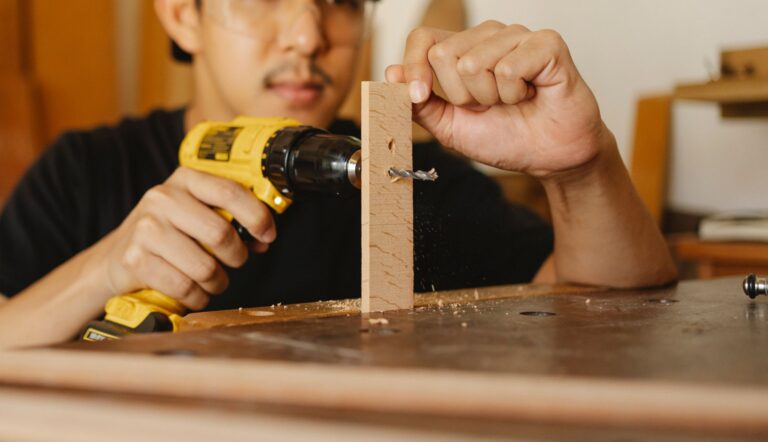
A cordless drill-driver is the tool you reach for to hang shelves, assemble furniture, mount curtain rods, and tighten loose hardware. Its value comes from speed and control, since one tool can drill pilot holes and drive screws without a tool swap.
Buy this one with a lithium-ion battery and a second battery pack in the box. That setup keeps the tool ready while the other pack charges, which matters more than extra torque for most home jobs.
Battery voltage affects feel, but mid-range 12V to 20V models handle most household work well. Higher voltage sounds stronger, yet drywall anchors, cabinet screws, and hinge repairs do not need a heavy contractor tool.
What to look for in a starter drill
Chuck size matters more than flashy claims. A 1/2-inch chuck accepts more common bits, and a variable-speed trigger gives you better control at the start of a screw, which helps keep bit tips from skating across painted surfaces.
A brushless motor is a smart upgrade because it runs cooler and wastes less energy through friction. That means longer runtime and less wear inside the tool, but brushed motors still work fine for occasional use and lower budgets.
Why cordless fits most homes
Cords slow you down in a hallway, on a ladder, or beside furniture you already moved twice. Cordless tools let you work at the front door, in a closet, or on a patio without hunting for an outlet.
That freedom matters in real homes because repairs rarely happen at a workbench. Once the drill is in hand, the next step is the tool that turns screw driving into a faster, cleaner job.
With fastening speed handled, the kit naturally widens to tools that shape edges and surfaces more cleanly.
Cuts, Fastening, and Finish Work That Come Next
The next layer of essential power tools for homeowners covers straight cuts, faster fastening, and cleaner surfaces. A circular saw handles lumber and plywood, an impact driver speeds up screw work, and a random orbital sander smooths the final surface before paint or stain.
Circular saws matter because sheet goods are awkward to move through a store-cut workflow, and a saw lets you trim them to size at home. A straightedge or guide clamp turns a rough tool into a reliable one, and that matters on closet shelves, subfloor patches, and simple shelving runs.
| Tool | Best home tasks | Why it helps |
|---|---|---|
| Circular saw | Straight cuts in plywood, lumber, and shelving | It handles long cuts that a jigsaw cannot keep straight. |
| Impact driver | Deck screws, lag-style fastening, furniture assembly | It drives long screws with less wrist strain than a drill. |
| Jigsaw | Curves, notch cuts, sink openings, outlet cutouts | It turns awkward shapes into manageable cuts. |
| Random orbital sander | Paint prep, wood smoothing, patch blending | It leaves a cleaner surface than hand sanding alone. |
Circular saw and impact driver in real use
A circular saw shines on a weekend shelf project because it gives you repeatable, straight cuts in pine, plywood, and melamine panels. An impact driver matters on the assembly side because repeated screw driving adds up fast, and the impact mechanism uses short rotational bursts that reduce cam-out on stubborn fasteners.
That burst action is a physical advantage, not just a marketing line. The hammering inside the tool transfers torque in pulses, so the bit keeps biting instead of slipping as easily when wood or metal resists.
Jigsaw and orbital sander for finish work
A jigsaw earns its spot the first time you cut around a pipe, curve a shelf corner, or open a hole for a sink basin. A thin blade can follow a line that a circular saw would never manage safely.
A random orbital sander uses a spinning and wobbling pad that spreads wear across the disc, which helps avoid grooves in soft wood. That movement is why it leaves a smoother surface than a straight spin sander, and it matters right before paint or stain.
A smoother finish often depends on the tools that follow, especially when a surface needs careful prep.
The Versatile Add-Ons That Stretch a Starter Kit
Some tools do their best work in awkward places where a standard saw or drill gets clumsy. The oscillating multi-tool, reciprocating saw, brad nailer, and miter saw sit in that group, and each one earns its place only after your main kit feels complete.
The oscillating multi-tool for tight repairs
In cramped corners and awkward gaps, this repair specialist slips in where larger tools cannot reach. It trims door casings, scrapes old caulk, flush-cuts nails, and reaches into corners where a larger blade would be useless.
Its small blade moves side to side at high speed with very little arc, so it can work flush against a floor or cabinet edge. That geometry is why it shows up during drywall patching, baseboard fixes, and grout cleanup around an older tub surround.
The reciprocating saw for rough removal
A reciprocating saw handles demolition, old lumber, cut-off pipes, and material that no longer deserves a clean edge. It is loud, coarse, and useful exactly because it is not delicate.
That saw matters during tear-outs because speed beats finish quality in demolition. You cut through framing, nails, and scrap material faster, which saves time before the cleaner tools take over.
Brad nailer and miter saw for bigger trim plans
A brad nailer belongs later in the lineup, after you start installing casing, baseboards, or light trim pieces that need many small fasteners. A miter saw comes next for repeated angle cuts in trim and framing stock, especially where consistency matters more than portability.
Those two tools point toward a more ambitious workshop path. For a homeowner replacing a single damaged board, they are optional; for anyone building out rooms, they become part of the regular rotation.
Those extras are useful, but they only pay off when the battery platform stays simple and consistent.
Cordless Platforms And The Brand Decision That Matters
Cordless vs corded power tools comes down to where you work and how often you move. Corded tools can run all day, but they tie you to an outlet and add extension cords, while cordless tools give you portable setup for stairs, garages, porches, and quick fixes.
The bigger decision is battery compatibility. A DeWalt, Milwaukee, Makita, Ryobi, or Bosch platform can power several tools with the same pack, which means your drill, impact driver, and saw can share batteries instead of each tool living alone.
| Choice | What it gives you | Where it fits |
|---|---|---|
| Cordless | Fast setup, portable use, shared batteries | Apartment fixes, yard repairs, ladder work, mixed rooms |
| Corded | Continuous power, no charging delay | Bench work, sanding, long indoor sessions near outlets |
| Single-brand battery platform | One charger, fewer pack types, easier storage | Starter kits that will grow over time |
Brand choice should follow ecosystem value, not name recognition alone. Ryobi often suits budget-conscious homeowners who want a broad catalog, while DeWalt, Milwaukee, Makita, and Bosch pull in users who want a wider pro-style range and more compact tool bodies.
That tradeoff helps you avoid the trap of buying a good drill on one battery system and a good saw on another. Once two chargers and two pack styles enter the closet, the kit starts working against you.
Consistency matters most when a starter kit has to fit the realities of small spaces and shared storage.
Starter Kits For Apartments, Condos, And Houses
Your living space shapes the kit more than your wish list does. A small apartment rarely needs a demolition saw, while a house with a garage and yard can justify a deeper starter set for repairs, furniture, and light renovation.
A lean kit for smaller spaces
- Cordless drill-driver for shelves, curtain rods, and furniture assembly.
- Compact impact driver for repeated screw work in tight rooms.
- Small jigsaw for occasional notch cuts in wood or plastic.
- Basic sander for patch smoothing and paint prep.
That lean setup keeps dust, noise, and storage pressure down. It fits a closet shelf, a hallway cabinet, or a small storage bin, which matters more than raw power in compact spaces.
A balanced kit for a typical house
A house kit often adds a circular saw, oscillating multi-tool, and reciprocating saw because walls, trim, and exterior fixes bring more varied work. That mix gives you enough reach for flooring patches, board cuts, and minor tear-out without jumping to contractor-grade gear.
Budget power tool starter kit planning works best in tiers. A lower-budget path starts with a drill, one battery, and a charger, then adds an impact driver next. A premium path starts with a full cordless platform and adds the saws later, which saves you from duplicate packs and chargers.
Match the kit to project load
Furniture assembly, picture hanging, and light hardware fixes ask for drill control more than brute force. Trim work, deck screws, and panel cuts push you toward faster fastening and straighter cutting, while patching, scraping, and small tear-out bring in the specialty tools.
That project-based filter keeps the purchase order honest. The best starter power tools for new homeowners are the ones that remove the most friction from the jobs already sitting on your list.
That practicality also raises the stakes for safety, organization, and avoiding purchases that create clutter instead of progress.
Safety, Storage, And Buying Mistakes To Avoid
Eye protection comes out before the trigger does. A sliver from plywood, a broken blade tooth, or a screw head that snaps under torque can fly farther than you expect, and a pair of wraparound glasses costs far less than an urgent care visit.
Check the blade, bit, or disc before each job, and seat the battery only after the accessory is mounted. That small habit cuts down on surprise starts and sloppy cuts.
Setup habits that save time
- Charge packs early so the tool is ready before the repair starts.
- Match the bit to the fastener head to reduce strip-out.
- Set the depth on a saw or nailer before cutting or fastening.
- Use scrap wood for the test cut before touching the project piece.
- Vacuum dust from vents and battery slots after messy jobs.
Those habits matter because small errors stack fast. A loose bit rounds out a screw, a dull blade wanders off line, and packed dust shortens tool life by trapping heat around the motor and electronics.
The mistakes that waste space and money
Buying too many specialty tools too soon is the common trap. A homeowner kit gets better results from a drill, saw, sander, and one good fastening tool than from a shelf full of gadgets used once a year.
Another mistake is ignoring the battery ecosystem. A single platform keeps your chargers, packs, and storage simple, while pro-grade power with features you never touch can drain budget that should go toward the tools you will use weekly.
Store the kit in one dry spot, keep blades and bits together, and label batteries with the date you put them into service. That kind of upkeep keeps essential power tools for homeowners ready for the next hinge repair, shelf install, or floor patch.
Proper maintenance closes the loop, keeping each tool ready when the next repair inevitably comes up.
What to Remember
The smartest homeowner kit starts with the tool that solves the widest mix of jobs, then grows toward cutting, smoothing, and specialty repair. A cordless drill-driver sets that base, and every tool after it should earn its spot by solving a real task in your space.
FAQ
What tools does every new homeowner need?
A new homeowner should start with a cordless drill-driver, a level, a measuring tape, a set of bits, and one good saw or sander. That mix handles hanging, assembly, and light fixes without cluttering storage.
What are the basic power tools you need at home?
A drill-driver, impact driver, circular saw, random orbital sander, and jigsaw cover most home projects with just a few tools. Those five cover most drilling, fastening, cutting, and finish tasks around the house.
What power tools should I buy first?
Start with a cordless drill-driver, then add an impact driver, then a circular saw. That order matches the most common repair work, from mounting hardware to cutting lumber and driving long screws.
Should I buy cordless or corded power tools?
Cordless works better for most homeowners because it moves from room to room, patio to garage, and ladder to closet without setup friction. Corded still makes sense for long sanding sessions or bench work near an outlet.
What is the best brand of power tools for homeowners?
A battery platform that matches your budget and future tool list usually matters more than the logo on the case. Ryobi fits many starter kits, while DeWalt, Milwaukee, Makita, and Bosch appeal to users who want broader platform choices.
Do I need a brushless motor right away?
A brushless motor helps with runtime and heat, but it is not a must for a starter kit. You can use a brushed drill-driver for years through normal homeowner projects, provided the batteries stay charged.